
round cake serving guide

Round Cake Serving Guide: An Overview

Planning a celebration? This guide details round cake sizes and servings, from intimate gatherings to large parties, ensuring everyone enjoys a delightful slice!

Understanding Cake Serving Sizes

Determining appropriate cake serving sizes involves considering several factors beyond simply the number of guests. Traditional slices are typically around 1.5 x 2 inches, offering a generous portion, but modern trends lean towards smaller, more manageable dessert portions.

The density of the cake significantly impacts serving counts; a light and airy angel food cake will yield more servings than a dense chocolate fudge cake of the same diameter. Furthermore, if a buffet includes other desserts, reducing cake slice sizes is advisable.

Understanding these nuances ensures you order or bake a cake that comfortably accommodates your guests without excessive waste, creating a satisfying and enjoyable experience for all attendees. Careful planning prevents dessert disappointment!

Determining Cake Size Based on Guest Count

Selecting the right cake size hinges on your guest list; 6-inch cakes suit small groups, while 12-inch cakes are ideal for larger celebrations.

6-Inch Round Cake: Ideal for Small Gatherings

A 6-inch round cake is perfectly suited for intimate celebrations, typically serving 8 to 12 guests. This size is excellent for small families, close friends, or a cozy couple’s anniversary. It’s a manageable size for bakers who are newer to cake decorating, offering a less daunting canvas for creative designs.

Consider a 6-inch cake when you’re aiming for a personal touch without excessive leftovers. It’s also a fantastic option if you’re serving other desserts alongside the cake, ensuring a balanced spread. This size allows for a beautiful presentation without being overwhelming, and it’s often a cost-effective choice for smaller events. Don’t underestimate the impact of a perfectly crafted, smaller cake!

8-Inch Round Cake: A Popular Choice for Medium-Sized Parties

The 8-inch round cake strikes a wonderful balance, making it a consistently popular choice for medium-sized gatherings. It comfortably serves 12-16 people, ideal for family birthdays, office celebrations, or casual get-togethers with friends. This size offers ample space for decorative elements, allowing for more elaborate frosting designs and personalized touches.

An 8-inch cake is versatile enough to accommodate various flavors and fillings, from classic vanilla to rich chocolate. It’s a practical size that provides enough cake for everyone to enjoy a generous slice without creating excessive waste. It’s also a great option if you anticipate a few extra guests, offering a little buffer in serving size.

10-Inch Round Cake: Serving Larger Groups

When hosting a sizable event, a 10-inch round cake is an excellent choice, comfortably serving 20-24 guests. This size is perfect for milestone birthdays, larger family reunions, or more substantial parties where a generous dessert offering is desired. The increased surface area allows for more intricate cake decorations and stunning visual presentations.

A 10-inch cake provides a substantial centerpiece and ensures there’s enough to go around, even with second helpings! It’s a practical solution for avoiding the need for multiple smaller cakes. Consider this size when you know you’ll have a crowd eager for a sweet treat, offering a delightful experience for all attendees.

12-Inch Round Cake: For Big Celebrations

For truly grand occasions and exceptionally large guest lists, a 12-inch round cake is the ultimate choice, typically serving 32-40 people. This impressive size is ideal for weddings, large corporate events, or any celebration where a significant dessert centerpiece is desired. It makes a bold statement and provides ample servings for a crowd.

A 12-inch cake allows for elaborate designs, multiple tiers (if desired), and a truly show-stopping presentation. It’s a fantastic option when you want to make a lasting impression and ensure everyone has a chance to indulge in a delicious slice. Planning for leftovers is also wise with this generous size!

Cake Serving Chart: Detailed Breakdown

Explore our comprehensive charts outlining suggested serving sizes for 6, 8, 10, and 12-inch round cakes, ensuring perfect portions for your event!

6-Inch Round Cake Serving Chart

A 6-inch round cake is wonderfully suited for smaller, more intimate celebrations – think family dinners, cozy gatherings with close friends, or a special occasion for just a few. Generally, a 6-inch cake will comfortably yield between 8 to 12 servings, depending on how generously each slice is cut.

For standard dessert portions, aiming for 12 servings is a safe bet. However, if you anticipate guests having larger appetites or enjoying a more substantial slice, planning for 8 servings is more realistic. Consider the overall dessert spread; if other sweets are available, smaller cake portions are perfectly acceptable. This size is also ideal for a small birthday celebration or a quiet anniversary.

Remember to factor in potential seconds!

8-Inch Round Cake Serving Chart

An 8-inch round cake strikes a delightful balance, making it a popular choice for medium-sized parties and gatherings. This versatile size typically serves between 12 and 16 guests, offering a sweet treat for a comfortable group. The exact number of servings depends, of course, on the desired slice size.

If you’re aiming for standard dessert portions, 16 servings are achievable with careful cutting. However, for more generous slices, or if the cake is particularly rich and decadent, planning for 12-14 servings is more practical. Consider the context of the event – a casual birthday party might warrant larger slices than a formal afternoon tea.

This size is perfect for office celebrations or family get-togethers!

10-Inch Round Cake Serving Chart

A 10-inch round cake is an excellent choice when catering to larger groups, comfortably serving between 20 and 24 people. This size provides ample cake for a substantial gathering, ensuring there’s enough to go around for seconds – or for those with a particularly sweet tooth! As with other sizes, serving counts are estimates.

Standard dessert portions allow for 24 servings, while more generous slices will yield around 20. Consider the overall menu; if other desserts are available, guests may opt for smaller cake portions. A beautifully decorated 10-inch cake also makes a stunning centerpiece.

It’s ideal for milestone birthdays or moderately sized celebrations!

12-Inch Round Cake Serving Chart

A 12-inch round cake is truly designed for big celebrations! This substantial size typically serves a generous 28 to 32 guests, making it perfect for weddings, large birthday parties, or any event with a significant headcount. It’s a statement piece that’s sure to impress.

Similar to other sizes, serving estimations depend on portion size. Standard dessert portions allow for 32 servings, while larger, more indulgent slices will yield around 28. If a buffet of desserts is offered, guests may choose smaller portions of cake.

This size is a fantastic choice when you want to ensure everyone gets a piece and potentially have leftovers!

Serving Styles & Portion Sizes

Consider traditional slices versus smaller dessert portions; serving size is affected by other treats offered, influencing how much cake guests will consume.

Traditional Slice vs. Smaller Dessert Portions

Historically, cake has been served in generous, triangular slices, a classic presentation for celebrations. However, modern dessert trends often favor smaller, more manageable portions. This shift accommodates guests who may want to sample multiple desserts or prefer a lighter indulgence.

A traditional slice typically measures around 1.5 to 2 inches wide at the base, offering a substantial serving. Conversely, smaller portions, like those seen with dessert buffets or alongside other sweets, might be 1 to 1.5 inches wide.

Choosing between these styles depends on the event’s formality and the overall dessert spread. A formal wedding might warrant traditional slices, while a casual party could benefit from varied, smaller portions, allowing guests to explore different flavors without overindulging. Ultimately, consider your audience and the desired experience.

Factors Affecting Serving Size (e.g., other desserts)

Determining appropriate cake serving sizes isn’t solely about the cake itself; several factors influence how much each guest will consume. If a dessert buffet features numerous options – cookies, pastries, fruit, and other sweets – guests will naturally take smaller cake portions.

Conversely, if cake is the sole dessert offering, larger slices are expected. The time of day also matters; afternoon teas often feature dainty portions, while evening celebrations may call for more substantial servings.

Consider the preceding meal; a heavy dinner might reduce appetite for a large dessert. Finally, guest demographics play a role – children typically require smaller portions than adults. Adjusting serving sizes based on these factors ensures minimal waste and maximum enjoyment.

Cake Layers and Serving Adjustments

Multi-layered cakes, with fillings and increased height, may yield slightly fewer servings compared to single-layer cakes of the same diameter, so plan accordingly.

Single-Layer Cakes: Simpler Serving

Single-layer round cakes present the most straightforward serving calculations. Because there’s no filling to account for, the serving size is directly related to the cake’s diameter and desired slice size. Generally, a standard serving is considered to be a wedge with a point angle of approximately 45 degrees. This allows for neat, even slices and ensures a reasonable portion for each guest.

For example, a 6-inch single-layer cake typically yields 8-12 servings, while an 8-inch cake can comfortably serve 12-16 people. Remember that these are estimates, and actual servings may vary based on individual appetites and how generously the slices are cut. When serving, a sharp knife and a rotating cake stand can greatly assist in achieving clean, professional-looking slices. Consider marking the cake beforehand to ensure consistent portion sizes.

Multi-Layer Cakes: Adjusting for Height & Filling

Multi-layer round cakes require a slight adjustment to serving estimations. The addition of filling and increased height significantly impacts the overall volume and potential servings. While the base diameter remains a key factor, you must consider the cumulative effect of each layer. A general rule is to increase the serving count by 20-30% compared to a single-layer cake of the same diameter.

For instance, an 8-inch three-layer cake with generous filling could easily serve 18-24 people. The type of filling also matters; denser fillings like buttercream will yield smaller servings than lighter mousses. Precise serving counts are challenging, but careful slicing – ensuring each slice includes a proportionate amount of cake and filling – is crucial for guest satisfaction.

Cake Density & Serving Counts

Cake density dramatically affects portion sizes; light, airy cakes allow for larger servings, while dense cakes, like pound cake, require smaller, richer portions.

Light & Airy Cakes (Angel Food, Chiffon)

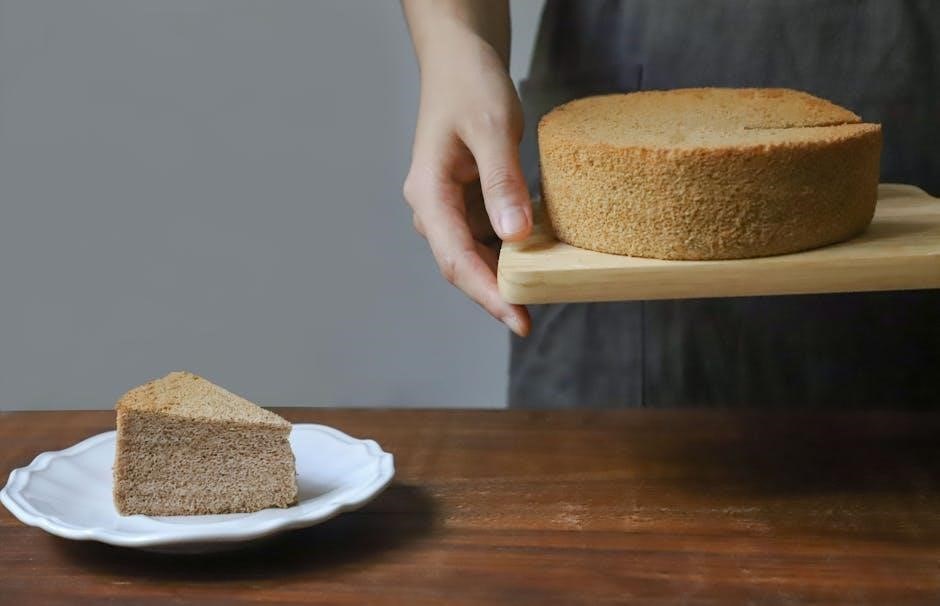
Angel food and chiffon cakes, celebrated for their delicate textures and ethereal lightness, present unique serving considerations. Due to their airy structure, these cakes naturally yield more servings per cake size compared to denser varieties. A 6-inch round can comfortably serve 12-16 people, while an 8-inch expands to 16-20.

The substantial volume created by whipped egg whites and minimal fat allows for generous portions without feeling overly rich. However, remember that these cakes often pair beautifully with fresh fruit and light sauces, which can influence individual serving sizes. Consider offering smaller slices if accompanied by other desserts or a full meal. Their delicate nature also means they are often enjoyed as a lighter dessert option.

Dense Cakes (Pound Cake, Chocolate Fudge)

Dense cakes, like rich chocolate fudge or classic pound cake, require a different approach to serving size estimations. Their substantial weight and intense flavors mean smaller portions are generally preferred to avoid overwhelming the palate. A 6-inch round typically serves 8-10 people, while an 8-inch yields 10-14 servings.

These cakes are incredibly satisfying, so guests often require less to feel content. Consider the richness of the cake when planning alongside other desserts; a smaller slice allows room for variety. Dense cakes also hold up well to accompaniments like whipped cream or berries, which can enhance the overall experience without drastically increasing portion sizes. Remember, quality over quantity is key!
Special Considerations: Wedding Cakes

Wedding cakes, often tiered, demand careful planning! Serving counts must account for potential favors, leftovers, and the celebratory nature of the event.

Wedding Cake Serving Guide – Tiered Cakes

Tiered wedding cakes present a unique serving challenge, requiring a slightly different approach than single-layer round cakes. Generally, a three-tiered cake can comfortably serve 100-150 guests, assuming standard 1×1 inch slices. However, this is a broad estimate, heavily influenced by tier sizes and desired portion generosity.

Consider the overall dessert spread; if multiple options are available, smaller cake portions are acceptable. A common guideline suggests 1-2 servings per guest, factoring in potential second slices or those who prefer other treats. Accurately calculating servings ensures a delightful experience for all attendees, avoiding shortages or excessive waste; Remember to consult with your baker for personalized recommendations based on your specific cake design and guest count.

Accounting for Favors & Leftovers

Beyond guest servings, factor in potential wedding favors involving cake – small boxed slices are a popular choice. Allocate approximately 5-10% of the total cake for these favors, depending on your guest list and favor plans. Don’t forget to anticipate leftovers! Many couples desire to keep the top tier for their first anniversary, requiring a dedicated portion.

Adding an extra 5-10% to your initial serving estimate accommodates unexpected guests or those wanting second slices. Careful planning minimizes waste and ensures a memorable experience. Consider donating any significant remaining cake to a local charity or shelter, spreading the joy beyond the celebration.

Beyond the Slice: Alternative Serving Methods

For variety, consider charming cake pops or mini desserts alongside the round cake, or opt for individually portioned cupcakes for easy enjoyment!

Cake Pops & Mini Desserts

Elevate your dessert spread by incorporating delightful cake pops and miniature desserts alongside your round cake. These bite-sized treats offer a playful alternative, providing guests with variety and portion control. Cake pops, crafted from crumbled cake and frosting, coated in chocolate, are visually appealing and easy to handle.

Mini desserts, such as cheesecakes, tarts, or mousse cups, add sophistication and cater to diverse preferences. They’re particularly useful for guests who prefer smaller indulgences or want to sample multiple flavors. Utilizing these options complements the main cake, reducing potential waste and enhancing the overall dessert experience. A well-rounded dessert table ensures there’s something for everyone to savor!

Cupcakes as a Serving Alternative

Considering cupcakes as an alternative to a traditional round cake offers convenience and individual portion control. Cupcakes eliminate the need for cutting, simplifying serving and minimizing mess. They also allow for a wider range of flavor combinations, offering guests more choices without requiring multiple cake layers.

Decorated cupcakes can be visually stunning, mirroring the aesthetic of a layered cake. They’re especially practical for events with varying guest counts, as you can easily adjust the number of cupcakes baked. Furthermore, cupcakes are portable and easy for guests to enjoy while mingling. This approach provides a delightful and fuss-free dessert option, perfectly suited for casual gatherings or larger celebrations.

zone 10b california planting guide

Zone 10b California Planting Guide: An Overview

Southern California’s mild climate allows for year-round gardening, but understanding Zone 10b’s specifics is crucial for successful harvests and vibrant landscapes.

Understanding Zone 10b

Zone 10b in California represents a region with minimal frost risk, boasting average annual minimum winter temperatures between 30°F and 35°F. This allows for an extended growing season, significantly longer than many other US regions; Gardeners benefit from the ability to cultivate a diverse range of plants, including subtropical varieties often impossible to grow elsewhere.

However, Zone 10b isn’t uniform. Coastal areas experience milder temperatures and higher humidity, while inland locations can see hotter summers and cooler winter nights. Understanding these nuances is key to selecting appropriate plant varieties and adjusting planting schedules. Successful gardening in Zone 10b requires awareness of these temperature variations and adapting strategies accordingly for optimal growth;

Microclimates within Zone 10b

Zone 10b California isn’t a monolithic gardening environment; significant microclimates exist. Coastal areas benefit from marine influence, offering moderate temperatures and higher humidity, ideal for moisture-loving plants. Inland valleys experience hotter summers and cooler winters, demanding heat-tolerant and frost-resistant selections.

Elevation plays a crucial role, with higher altitudes experiencing cooler temperatures. South-facing slopes receive more sunlight, warming soil faster, while north-facing slopes remain cooler and retain moisture longer. Even within a single garden, structures like walls and trees create sheltered spots or shaded areas. Recognizing and utilizing these microclimates allows gardeners to expand the range of plants they can successfully cultivate within Zone 10b.

Vegetable Planting Schedule for Zone 10b

Zone 10b’s extended growing season enables nearly year-round vegetable cultivation, but strategic timing—considering cool and warm seasons—is vital for optimal yields.

Cool Season Vegetables

Zone 10b’s mild winters present a unique opportunity for thriving cool-season vegetable gardens. These crops prefer temperatures between 60-70°F, making fall and early spring ideal planting times. Consider varieties like lettuce, spinach, kale, and broccoli, which flourish in cooler conditions. Root vegetables such as carrots, radishes, and beets also perform exceptionally well during these periods.

Succession planting is key to a continuous harvest. Staggering plantings every few weeks ensures a steady supply throughout the cool season. Remember to provide adequate moisture and well-drained soil for optimal growth. Protecting young seedlings from potential frost is also advisable, especially during colder snaps. Utilizing row covers can offer effective protection and extend the growing season further.

Best Planting Times for Cool Season Crops

For Zone 10b California gardens, the prime time for sowing cool-season vegetable seeds is typically from September through February. Starting seeds indoors in late summer (August-September) allows for transplants to be established before the cooler weather fully arrives. Direct sowing can occur from October onwards, benefiting from the milder temperatures.

Leafy greens like lettuce and spinach can be planted throughout the fall and winter. Root vegetables, such as carrots and radishes, thrive when sown from October to January. Broccoli and cauliflower benefit from a September-November planting window. Consider a final planting in late February to extend the harvest into spring. Adjust these timings slightly based on specific microclimates within your garden.

Specific Cool Season Vegetables & Timing

Lettuce & Spinach: Sow seeds or transplants September-February for continuous harvests. Succession planting every 2-3 weeks ensures a steady supply. Radishes: Direct sow October-January, maturing quickly in about a month. Carrots: Plant seeds October-February; choose shorter varieties for heavier soils.

Broccoli & Cauliflower: Start seeds indoors August-September, transplanting September-November. Peas: Sow seeds September-December for a winter/early spring harvest. Kale: Plant seeds or transplants September-February, enjoying harvests throughout the cooler months. Remember to adjust planting times based on your local microclimate and consider using row covers for added protection against frost.

Warm Season Vegetables

Zone 10b’s extended warm season allows for a diverse range of summer vegetables. Tomatoes & Peppers: Start seeds indoors February-March, transplanting after the last frost (typically April-May). Consider heat-tolerant varieties. Cucumbers & Zucchini: Direct sow or transplant April-June for summer harvests; succession plant for continuous yields.

Beans: Sow seeds March-July, choosing bush or pole varieties. Eggplant: Start seeds indoors February-March, transplanting in May. Corn: Plant seeds April-June, ensuring adequate pollination. Southern California’s sun and warmth are ideal, but consistent watering and soil amendments are vital for optimal growth and abundant harvests.

Optimal Planting Windows for Warm Season Crops

For Zone 10b, the prime window for warm-season vegetables stretches from late March through August, though many crops benefit from staggered planting. Tomatoes & Peppers thrive when transplanted from indoors between April and June, capitalizing on warming soils. Cucumbers & Zucchini excel with direct sowing or transplanting from April to July, allowing for multiple harvests.

Beans demonstrate flexibility, flourishing with sowing from March to July. Eggplant prefers a May transplant. Corn benefits from April-June planting. Remember, these are guidelines; microclimates within Zone 10b can shift these windows slightly, so observe local conditions.

Detailed Warm Season Vegetable Schedule

March-April: Begin with tomatoes, peppers, & eggplant (start indoors 6-8 weeks prior). Direct sow beans & corn. Succession sow radishes for early harvests.

May-June: Transplant tomatoes, peppers, & eggplant. Direct sow cucumbers, zucchini, & summer squash. Continue bean sowing for extended yields. Plant basil alongside tomatoes for pest control.

July-August: Second planting of beans, cucumbers, & zucchini for fall harvest. Consider heat-tolerant varieties. Monitor for pests and adjust watering based on increasing temperatures. Prepare beds for fall cool-season crops.

Fruit Tree Planting in Zone 10b

Zone 10b’s warm climate is ideal for citrus, avocado, & subtropical fruits; proper selection and planting timing are key for abundant yields.

Citrus Trees

Citrus trees thrive in Zone 10b’s mild winters and warm summers, offering a delightful array of options for home gardeners. Varieties like oranges, lemons, grapefruits, and mandarins flourish with proper care. Planting is best done in late winter or early spring, allowing roots to establish before the heat of summer.

Ensure well-draining soil, as citrus trees are susceptible to root rot. Amending with compost enriches the soil and provides essential nutrients. Regular watering is crucial, especially during dry periods, but avoid overwatering. Protect young trees from frost with coverings during occasional cold snaps. Pruning helps maintain shape and encourages fruit production. Consider dwarf varieties for smaller gardens, maximizing yields in limited spaces.

Avocado Trees

Avocado trees are a rewarding addition to Zone 10b gardens, but require specific attention to thrive. Planting is ideally done in spring or early summer, allowing sufficient time for establishment before winter. Choose a location with well-draining soil, as avocados are highly sensitive to root rot. Grafted varieties are recommended for reliable fruit production and quicker maturity.

Protect young trees from strong winds and frost. Consistent watering is vital, especially during fruit development. Avocado trees benefit from regular fertilization with a balanced citrus or avocado-specific formula. Pruning is essential for shaping the tree and removing dead or diseased branches. Pollination can be a concern; consider planting multiple varieties for cross-pollination and increased yields.

Subtropical Fruits

Zone 10b’s warm temperatures support a diverse range of subtropical fruits beyond citrus and avocados. Consider planting guava, papaya, figs, and passion fruit for a bountiful harvest. These fruits generally require full sun and well-drained soil. Planting times vary; figs are best planted in late winter or early spring, while papaya thrives when planted after the last frost.

Regular fertilization is crucial for optimal growth and fruit production. Protect sensitive varieties from frost with coverings or by planting in sheltered locations. Pruning helps maintain shape and encourages fruiting. Be mindful of potential pest and disease issues specific to each fruit type, employing organic control methods whenever possible. Enjoy the exotic flavors of homegrown subtropical delights!

Herb Gardening in Zone 10b

Zone 10b’s climate is ideal for both perennial and annual herbs, offering fresh flavors year-round with minimal effort and consistent growth.

Perennial Herbs

Zone 10b’s warm temperatures support a wide array of perennial herbs, offering a continuous harvest for years with minimal replanting. Rosemary, thyme, oregano, and lavender thrive, becoming established woody shrubs. Consider their mature size when planting, ensuring adequate space for growth and air circulation. Sage also flourishes, providing both culinary and ornamental value.

Mint, while a perennial, can be invasive; planting it in containers is highly recommended to control its spread. These herbs generally prefer well-drained soil and benefit from regular pruning to encourage bushier growth and prevent legginess. Proper care ensures a bountiful supply of flavorful herbs throughout the year, enhancing your culinary creations and adding fragrance to your garden.

Annual Herbs

While Zone 10b favors perennials, several annual herbs provide vibrant flavor and aroma during their growing season. Cilantro and dill are popular choices, best sown directly into the garden in succession for a continuous supply, as they bolt quickly in warmer weather. Basil, though technically a tender perennial, is often grown as an annual, offering abundant leaves throughout the summer months.

Chamomile and summer savory also perform well as annuals, adding unique flavors to teas and culinary dishes. These herbs generally require full sun and well-drained soil. Regular harvesting encourages bushier growth and delays flowering, maximizing leaf production. Remember to replant each season to enjoy their fresh flavors year-round.

Flower Planting Guide for Zone 10b

Zone 10b’s long growing season supports diverse blooms year-round; careful selection ensures continuous color and attracts beneficial pollinators to your California garden.

Spring Blooming Flowers

As temperatures gently rise in Zone 10b California, spring unveils a spectacular array of floral possibilities. Consider vibrant California poppies for a native touch, or cheerful snapdragons adding vertical interest. Petunias thrive, offering a cascade of color, while fragrant sweet peas perfume the air.

Don’t overlook the classic beauty of pansies and violas, perfect for borders and containers. Bulbs planted in fall, like daffodils and tulips (though requiring chilling), burst into bloom. Geraniums also flourish, providing long-lasting color. Remember to provide consistent moisture and well-drained soil for optimal spring flower displays. Succession planting with different varieties extends the blooming period, ensuring a continuously colorful garden throughout the season.

Summer Blooming Flowers

Zone 10b California’s warm summers are ideal for a profusion of vibrant blooms. Zinnias are heat-tolerant and attract butterflies, while marigolds offer cheerful color and pest-repelling properties. Sunflowers provide dramatic height and attract beneficial pollinators. Cosmos are easy to grow and offer delicate, airy blooms.

Consider salvia for its long-lasting flower spikes and drought tolerance. Lantana thrives in the heat, attracting butterflies with its clusters of colorful flowers. Portulaca (moss rose) is a low-growing, drought-resistant option. Regular deadheading encourages continued blooming throughout the summer months. Ensure adequate watering, especially during heat waves, to keep your summer flowers thriving and vibrant.

Seed Starting & Transplants

Starting seeds indoors extends the growing season, while hardening off transplants gradually acclimates them to outdoor conditions in Zone 10b.

Starting Seeds Indoors

For Zone 10b gardeners, initiating seeds indoors provides a head start, particularly for warm-season crops. Utilize seed-starting mixes, ensuring excellent drainage, and maintain consistent moisture. Supplemental lighting is often necessary, especially during shorter winter days, to prevent leggy seedlings.

Small seed varieties benefit greatly from indoor starting, as direct sowing can be challenging. Monitor temperatures closely; warmth encourages germination. Once seedlings emerge, gradually lower temperatures to promote robust growth. Proper ventilation prevents fungal diseases.

Consider using seed trays or individual pots for easy transplanting. Remember to label everything clearly! Timing is key – start seeds 6-8 weeks before the last expected frost, adjusting based on the specific vegetable’s needs.

Hardening Off Transplants

Zone 10b’s generally mild weather doesn’t eliminate the need for hardening off transplants. This crucial step acclimates seedlings grown indoors to outdoor conditions, preventing shock. Begin by placing seedlings in a sheltered spot, protected from direct sun and wind, for just an hour or two.

Gradually increase the exposure time each day, extending it to a full day outdoors over a week or ten days. Monitor plants closely for signs of stress, like wilting or leaf burn. If conditions are harsh, bring them back indoors.

Consistent moisture is vital during hardening off. Protect from sudden temperature drops, especially overnight. This process builds resilience, ensuring successful establishment in your California garden.

Soil Preparation & Amendments

Zone 10b soils vary, but benefit from organic matter additions like compost. This improves drainage, aeration, and nutrient retention for thriving plants in California.

Soil Types in Zone 10b

Zone 10b in California presents diverse soil conditions, often varying significantly even within a single property. Commonly encountered are clay soils, known for their poor drainage but high nutrient content. Sandy soils, conversely, drain rapidly but struggle to retain essential nutrients and moisture. Loamy soils, a balanced blend of sand, silt, and clay, are generally considered ideal, offering good drainage and fertility.

Many areas also feature alkaline soils, a characteristic of the region’s geology, which can impact nutrient availability for certain plants. Understanding your specific soil type is paramount. A simple squeeze test can provide initial insights – clay feels sticky, sand gritty, and loam a balanced texture. Professional soil testing is highly recommended to determine pH levels and nutrient deficiencies, guiding appropriate amendment strategies for optimal plant growth.

Composting & Organic Matter

Enhancing Zone 10b’s soils with compost and organic matter is fundamental for thriving gardens. Composting kitchen scraps, yard waste, and other organic materials creates a nutrient-rich amendment that improves soil structure, drainage, and water retention. This is particularly beneficial for clay and sandy soils prevalent in the region.

Regularly incorporating compost, well-rotted manure, or other organic amendments like leaf mold builds soil fertility naturally, reducing the need for synthetic fertilizers. Organic matter also supports beneficial soil microbes, crucial for nutrient cycling and plant health. Consider sheet mulching or lasagna gardening techniques to build soil directly in garden beds. Utilizing locally sourced organic materials aligns with sustainable gardening practices and promotes a healthy ecosystem within your California garden.

Watering Practices

Zone 10b’s warm temperatures demand mindful watering; efficient irrigation and water conservation are key to maintaining healthy plants and minimizing waste.

Efficient Irrigation Techniques

Given Zone 10b’s often dry conditions, employing efficient irrigation is paramount. Drip irrigation delivers water directly to plant roots, minimizing evaporation and reducing water waste significantly. Soaker hoses offer a similar benefit, gently releasing water along rows of plants. Avoid overhead sprinklers, as they lose substantial water to evaporation, especially during warmer parts of the day.

Mulching around plants is another crucial technique, helping to retain soil moisture and suppress weed growth, which competes for water. Consider grouping plants with similar water needs together – this “hydrozoning” approach allows for targeted watering. Regularly check your irrigation system for leaks and ensure emitters are functioning correctly to maximize efficiency and conserve this precious resource.

Water Conservation Strategies

Water conservation is vital in Zone 10b California gardens. Utilize rainwater harvesting systems – even a simple rain barrel can collect significant amounts of water for irrigation. Greywater systems, reusing water from showers and sinks (where permitted by local regulations), offer another sustainable option. Choose drought-tolerant plant varieties adapted to the Mediterranean climate, reducing overall water demands.

Improve soil health with ample organic matter; healthy soil retains moisture better. Water deeply but less frequently, encouraging deep root growth, making plants more resilient. Schedule irrigation for early mornings or late evenings to minimize evaporation. Consider xeriscaping principles, designing landscapes that require minimal supplemental watering, focusing on native and adapted plants.

Pest & Disease Management

Zone 10b gardens face pests like aphids and diseases from humidity; organic methods, including beneficial insects and proper air circulation, are key.

Common Pests in Zone 10b

Zone 10b California gardens, blessed with a long growing season, unfortunately also attract a variety of pests. Aphids are incredibly common, often clustering on new growth and sucking plant sap, leading to distorted leaves and reduced vigor. Whiteflies are another frequent issue, particularly on warm-season vegetables, causing similar damage. Spider mites thrive in dry conditions, creating webbing and stippling on foliage.

Larger pests like caterpillars can defoliate plants quickly, while snails and slugs target tender seedlings and low-growing crops. Gophers and other rodents pose a threat to root systems. Additionally, fruit trees are susceptible to pests like scale insects and fruit flies. Regular garden inspection is vital for early detection and intervention, preventing widespread infestations and protecting your valuable plants.

Organic Pest Control Methods

Zone 10b California gardeners have excellent options for managing pests without harsh chemicals. Introducing beneficial insects like ladybugs and lacewings can naturally control aphids and other soft-bodied pests. Companion planting, such as marigolds near tomatoes, deters nematodes and other harmful insects. Regularly hand-picking pests like caterpillars and snails is surprisingly effective.

Neem oil is a versatile organic insecticide, disrupting insect life cycles. Insecticidal soap effectively controls aphids, whiteflies, and spider mites. Diatomaceous earth (DE) creates a physical barrier against crawling insects. Maintaining healthy soil and strong plants boosts their natural resistance. Crop rotation and removing infested plant debris also minimize pest populations, fostering a thriving, balanced garden ecosystem.

Succession Planting for Continuous Harvest

Zone 10b’s mild weather enables continuous harvests through staggered planting schedules; plan multiple sowings for extended yields of favorite vegetables and herbs.

Extending the Growing Season

Zone 10b’s remarkably mild winters and long growing season present unique opportunities to maximize garden productivity. Utilizing techniques like row covers and cold frames can protect sensitive plants from occasional frosts, effectively lengthening the harvest period. Consider planting cool-season crops in the fall for winter and early spring yields, while warm-season varieties can be enjoyed well into autumn.

Strategic succession planting, as mentioned previously, is also key. By staggering planting dates, you ensure a continuous supply of fresh produce. Furthermore, selecting varieties with differing maturity rates allows for a prolonged harvest window. Don’t underestimate the power of microclimates within your garden; sheltered spots can offer a warmer environment, extending the growing season even further. Careful planning and these simple methods unlock year-round gardening potential.

Planning for Multiple Harvests

Successful gardening in Zone 10b hinges on anticipating continuous yields. Implement a detailed planting schedule, staggering sowings of the same crop every few weeks to ensure a consistent supply. Focus on “cut-and-come-again” varieties of lettuce, spinach, and herbs, allowing for repeated harvests from a single planting. Interplant fast-maturing crops, like radishes, between slower-growing ones, maximizing space and time.

Consider succession planting with different plant families to avoid soil depletion and pest build-up. For example, follow a legume crop with a leafy green. Utilize vertical gardening techniques to increase yields in limited spaces. Careful record-keeping of planting dates and harvest times will refine your schedule each season, leading to abundant, ongoing harvests throughout the year.

fate samurai remnant trophy guide

Fate/Samurai Remnant Trophy Guide ─ Overview

Fate/Samurai Remnant boasts an impressive trophy collection, featuring a total of 82 achievements for dedicated PlayStation hunters to pursue and unlock.

The game includes one coveted Platinum trophy, alongside four Gold, eight Silver, and a substantial sixty-nine Bronze trophies, offering a lengthy challenge.

Total Number of Trophies

Fate/Samurai Remnant presents a comprehensive trophy list, designed to challenge and reward dedicated players. The game features a grand total of 82 trophies available for acquisition on the PlayStation platform. This substantial number ensures a lengthy and engaging trophy-hunting experience for those aiming for full completion.

Breaking down the distribution, players will encounter 69 Bronze trophies, forming the bulk of the achievements. Complementing these are 8 Silver trophies, offering a step up in difficulty and prestige. Further adding to the challenge are 4 Gold trophies, reserved for significant accomplishments within the game. Finally, the ultimate reward – the coveted Platinum trophy – awaits those who conquer all other challenges. The base game itself contains 45 trophies, with an additional 37 spread across the three DLC packs.

Platinum Trophy Details

The Platinum trophy in Fate/Samurai Remnant, representing the pinnacle of achievement, is awarded for obtaining all other trophies within the game and its associated DLC content. This singular achievement signifies complete mastery of the game’s challenges, story, and systems, demanding significant time and dedication from the player.

Earning this prestigious trophy requires unlocking all 69 Bronze, 8 Silver, and 4 Gold trophies, alongside the 37 trophies introduced through the three DLC packs. Players should anticipate a substantial time investment, potentially exceeding dozens of hours, to achieve 100% completion. The Platinum trophy itself is named “All Trophies”, a straightforward acknowledgment of the player’s comprehensive accomplishment. It serves as a testament to their skill and perseverance within the world of Fate.

Estimated Completion Time

Estimating the completion time for Fate/Samurai Remnant’s trophy list is complex, heavily influenced by player skill, chosen difficulty, and dedication to 100% completion. A playthrough focusing solely on the main story and essential trophies could take approximately 30-40 hours for experienced players.

However, achieving the Platinum trophy, encompassing all 82 achievements including DLC content, significantly extends this timeframe. Expect a minimum of 60-80 hours, potentially exceeding 100 hours for those seeking optimal efficiency or struggling with challenging combat encounters. The DLC packs add considerable playtime due to their additional story content and unique trophies. Thorough exploration, mastering combat mechanics, and diligent item farming are crucial for minimizing completion time. Dedicated trophy hunters should prepare for a lengthy, but rewarding, journey.

Difficulty Assessment

Fate/Samurai Remnant’s trophy difficulty is generally considered moderate to high, primarily due to the demanding combat system and the sheer number of trophies requiring extensive grinding or specific in-game actions. While the main story presents a manageable challenge on normal difficulty, certain trophies necessitate mastering character skills and exploiting enemy weaknesses.

The game’s combat demands precise timing and strategic thinking, potentially frustrating players unfamiliar with action RPGs. Several trophies involve completing challenging side quests or defeating powerful optional bosses, adding to the overall difficulty. Furthermore, the DLC content introduces new challenges and trophies that further increase the game’s complexity. A Platinum run requires patience, dedication, and a willingness to learn the intricacies of the battle system.

Trophy List Breakdown

Fate/Samurai Remnant’s trophies are categorized by rarity: 69 Bronze, 8 Silver, 4 Gold, and 1 prestigious Platinum, offering diverse challenges for completionists.

Bronze Trophies ⏤ Early Game

Several Bronze trophies are readily obtainable during the initial stages of Fate/Samurai Remnant, primarily focusing on story progression and basic gameplay mechanics. “A Blinding Night” is awarded upon completing the Prologue, serving as a straightforward starting point for trophy hunters.

“Demonic Revelry” unlocks after finishing Chapter I, continuing the narrative-driven trophy acquisition. Players can also earn trophies like “First Encounter” and others tied to specific story beats within the early chapters. These trophies generally require simply playing through the game and experiencing the unfolding story.

Early exploration and interaction with NPCs can also yield some easy Bronze trophies, encouraging players to fully immerse themselves in the world of Fate/Samurai Remnant. These initial achievements provide a solid foundation for building momentum towards the more challenging trophies later in the game.

Bronze Trophies ─ Mid-Game

As players progress into the mid-game of Fate/Samurai Remnant, the Bronze trophies begin to require a bit more engagement with the combat system and exploration elements. Completing Chapters II and III will unlock several story-related trophies, continuing the trend of narrative progression.

Expect trophies tied to defeating specific enemy types or completing side quests that become available during this portion of the game. Mastering basic combat techniques and utilizing the Spirit Change system effectively will be crucial for overcoming some of these challenges.

Furthermore, discovering hidden locations and interacting with various NPCs will reward players with additional Bronze achievements. These mid-game trophies serve as a bridge between the introductory phase and the more demanding challenges that await in the late game, demanding consistent effort.

Bronze Trophies ⏤ Late Game

The late-game Bronze trophies in Fate/Samurai Remnant demand a thorough understanding of the game’s mechanics and a dedication to completion. Many are tied to finishing the final chapters, uncovering all story branches, and achieving specific outcomes in character interactions.

Expect trophies for defeating challenging optional bosses and mastering advanced combat techniques, including precise timing with Spirit Change abilities. Exploration becomes vital, as hidden items and secret areas often hold the key to unlocking these achievements.

Completing all side quests and maximizing character relationships will also contribute significantly to the Bronze count. These late-game trophies represent a final test of a player’s skill and commitment, requiring patience and a willingness to explore every facet of the game.

Silver Trophies ⏤ Combat & Challenges

Fate/Samurai Remnant’s Silver trophies focused on combat and challenges truly test a player’s mastery of the battle system. These achievements require skillful execution of combos, precise timing with parries and dodges, and strategic utilization of Spirit Change forms.

Expect trophies for defeating specific enemy types using particular strategies, completing difficult combat trials, and achieving high ranks in arena battles. Mastering the unique abilities of each Servant and understanding enemy weaknesses are crucial for success.

Furthermore, some Silver trophies demand completing challenging side quests that involve complex combat scenarios. These achievements aren’t simply about brute force; they require tactical thinking and adaptability. Prepare for demanding encounters!

Silver Trophies ⏤ Story Progression

Fate/Samurai Remnant’s Silver trophies tied to story progression signify significant milestones within the narrative. These aren’t simply awarded for reaching certain chapters; they often require specific choices, completing key side quests related to the main plot, or achieving particular outcomes during crucial story events.

Players can anticipate trophies for fully developing relationships with important characters, uncovering hidden lore, and making decisions that impact the storyline’s direction. Reaching pivotal moments in the narrative, such as completing major chapters or resolving significant conflicts, will unlock these achievements.

Successfully navigating complex dialogue options and understanding the nuances of character interactions are essential for obtaining all Silver trophies related to story progression. Expect a rewarding experience!

Gold Trophies ⏤ Masteries & Completion

Fate/Samurai Remnant’s Gold trophies represent a significant commitment to mastering the game’s systems and achieving comprehensive completion. These aren’t easily earned; they demand dedication, skill, and a thorough understanding of the game’s mechanics.

Expect trophies tied to maxing out character skills, completing all side quests, unlocking all character endings, and achieving high ranks in various gameplay systems. Mastering the combat system, including utilizing all Spirit Changes and perfecting parry timings, will likely be required.

Furthermore, these Gold achievements often involve collecting all items, fully upgrading equipment, and uncovering all hidden secrets within the game world. Prepare for a challenging, yet rewarding, pursuit of mastery!

Platinum Trophy ─ “All Trophies”

The ultimate accolade in Fate/Samurai Remnant, the Platinum trophy, is awarded for the incredibly demanding task of unlocking all other trophies within the game and its associated DLC packs. This represents a true testament to a player’s dedication and skill.

Earning this prestigious reward requires completing every challenge, mastering every combat system, uncovering all secrets, and fully experiencing the narrative through multiple playthroughs and character endings. Expect a significant time investment – potentially exceeding 50+ hours – and a high level of proficiency.

Successfully obtaining the Platinum trophy signifies complete mastery of Fate/Samurai Remnant, solidifying your status as a true champion of the game!

Missable Trophies

Fate/Samurai Remnant contains both story-related and gameplay-dependent trophies that can be missed, demanding careful attention to choices and completionist strategies.

Story-Related Missable Trophies

Several trophies are intrinsically tied to the narrative progression of Fate/Samurai Remnant, making them potentially missable if specific actions aren’t undertaken during particular chapters. Players must prioritize dialogue choices and side quests, as neglecting these can permanently lock certain achievements.

For instance, completing all character interlude quests before the final chapter is crucial, as these become inaccessible afterward. Failing to fully explore character relationships and resolve their storylines will prevent unlocking associated trophies.

Furthermore, certain story branches offer unique outcomes and trophies; selecting the incorrect path can lead to missing these opportunities. It’s highly recommended to consult a detailed walkthrough or guide to ensure no critical story beats are overlooked, guaranteeing a complete trophy collection.

Save scumming is advised for pivotal decisions!

Gameplay-Related Missable Trophies

Beyond the main storyline, Fate/Samurai Remnant features several gameplay-centric trophies susceptible to being missed. These often involve completing specific challenges, mastering certain combat techniques, or acquiring unique items within limited windows of opportunity.

For example, achieving maximum affinity with all supporting characters requires diligent gift-giving and consistent interaction throughout the game; failing to maintain these relationships can lock related trophies. Similarly, completing all arena challenges before the end credits is essential, as they become unavailable afterward.

Don’t overlook hidden collectibles or side activities, as some trophies are tied to their completion. Thorough exploration and consistent engagement with all gameplay systems are vital to avoid missing these achievements.

Regularly check your trophy progress!

DLC Trophy Considerations

Fate/Samurai Remnant expands its trophy list with three DLC packs, adding substantial content and 37 additional achievements to pursue for completionists.

Trophy Pack 1 Trophies

Trophy Pack 1 for Fate/Samurai Remnant introduces a new set of challenges and rewards, adding to the game’s already extensive trophy list. This pack primarily focuses on expanding the narrative and introducing new character interactions, resulting in trophies tied to specific story events and dialogue choices.

Players can expect around twelve Bronze trophies within this pack, often earned through progressing through the added story content and achieving certain milestones within the new scenarios. These trophies generally require attentive gameplay and exploration of the new areas introduced. Expect some trophies related to completing battles with specific conditions or utilizing unique character abilities during the new story segments.

Successfully navigating the intricacies of Trophy Pack 1 will require a blend of strategic combat and careful attention to the unfolding narrative, offering a rewarding experience for dedicated trophy hunters.

Trophy Pack 2 Trophies

Trophy Pack 2 for Fate/Samurai Remnant delves deeper into character relationships and expands upon existing storylines, presenting a fresh wave of trophies for players to unlock. This pack leans heavily into character-specific quests and challenges, demanding a thorough understanding of each servant’s abilities and backstories.

Expect approximately ten Bronze trophies within this pack, primarily awarded for completing unique character quests, achieving high bond levels with specific servants, and mastering new combat techniques. Several trophies will likely require players to make specific dialogue choices that influence character relationships and unlock hidden story paths.

Successfully obtaining all trophies from Pack 2 necessitates a commitment to exploring the nuances of each character and mastering the game’s intricate combat system, offering a fulfilling experience for dedicated players.

Trophy Pack 3 Trophies

Trophy Pack 3 for Fate/Samurai Remnant represents the final layer of challenges, focusing on ultimate mastery of the game’s systems and a deep understanding of its lore. This pack introduces exceptionally difficult combat scenarios and intricate puzzle-solving elements, pushing players to their limits.

Players can anticipate around eight Bronze trophies, earned through completing exceptionally challenging battles, discovering hidden secrets within the game world, and achieving perfect scores on specialized training missions. A single Silver trophy is likely included, awarded for completing all content within the pack.

Successfully unlocking all trophies in Pack 3 signifies a complete and thorough experience with Fate/Samurai Remnant, demonstrating a player’s dedication and skill. Prepare for intense battles and rewarding discoveries!

Useful Tips & Strategies

Mastering combat requires strategic skill usage, precise timing, and exploiting enemy weaknesses. Farming specific items involves revisiting key locations and utilizing efficient battle strategies.

Combat Strategies for Difficult Trophies

Engaging in challenging battles within Fate/Samurai Remnant demands a nuanced approach to combat. Prioritize understanding enemy attack patterns and exploiting their vulnerabilities with targeted skills. Utilizing the Spirit Change system effectively is crucial; switching between stances grants access to unique abilities and defensive options.

For particularly tough encounters, focus on building and maintaining your Extra Attack gauge to unleash devastating special moves. Don’t underestimate the power of Noble Phantasms – timing their activation can turn the tide of battle. Mastering parrying and dodging is essential for minimizing damage and creating openings for counterattacks. Experiment with different Servant combinations to discover synergistic strategies that complement your playstyle. Remember to upgrade your equipment and skills regularly to stay ahead of the escalating difficulty.

Finally, consider lowering the difficulty temporarily if you’re consistently struggling with a specific trophy, then returning to your preferred setting once you’ve mastered the encounter.

Farming Locations for Specific Items

Efficient item farming is vital for progressing through Fate/Samurai Remnant and unlocking certain trophies. For Skill Experience, consistently replay early-game story chapters on lower difficulties, focusing on battles with numerous weaker enemies. Spirit Origin Stones can be reliably obtained by completing side quests in the Anytown area and exploring hidden chests.

To acquire Rare Materials needed for equipment upgrades, target specific enemy types in later-game regions; consult online resources for drop rate information. The Izumo region is known for yielding valuable crafting components. Repeatedly challenge high-level Extra Battles for a chance to obtain exclusive items and materials. Remember to utilize item duplication features where available to maximize your gains.

Finally, regularly check shops in major towns, as their inventories refresh periodically with potentially useful items.

death knight frost leveling guide

Welcome, aspiring Frost Death Knight! This comprehensive guide details efficient leveling strategies, from talents and rotations to gear and dungeon tips.

We’ll cover everything needed to swiftly navigate the leveling experience, maximizing your damage and survivability. Prepare for a chilling journey!

This guide will help you understand the core mechanics and optimize your gameplay for a smooth and enjoyable leveling process.

Remember to consult resources like WoWHead and Icy Veins for additional information and updates.

Let’s begin your ascent to power as a master of Frost!

Overview of Frost DK Leveling

Frost Death Knights excel at sustained damage and control, making them remarkably effective levelers. The class thrives on strategically utilizing slows and freezing effects to manage enemy encounters. Early levels focus on building Runic Power through Frost Strike and utilizing abilities like Frost Nova for crowd control.

As you progress, Death and Decay becomes a powerful tool for cleaving down groups of enemies. Mastering the rotation and understanding Runic Power management are crucial for maximizing efficiency. Remember to prioritize talents that enhance your damage output and survivability throughout the leveling journey.

Frost DKs offer a balanced experience, capable of handling both single targets and multiple foes with ease.

Why Choose Frost for Leveling?

Frost Death Knights offer exceptional survivability due to inherent self-healing and defensive cooldowns. This resilience minimizes downtime and allows for consistent progression. The spec’s strong AoE capabilities, particularly with Death and Decay, accelerate questing and dungeon completion.

Furthermore, Frost DKs boast excellent control, effectively slowing and freezing enemies, simplifying challenging encounters. The class’s relatively straightforward rotation makes it beginner-friendly, while still offering depth for optimization.

You’re a cleave machine, easily handling groups, and the consistent damage output ensures swift leveling.

Talent Builds for Efficient Leveling

Optimizing your talent choices is crucial! We’ll explore core talents for maximizing damage and survivability, alongside optional selections for varied playstyles.

These builds prioritize efficient leveling speed and ease of use.

Core Talents for Frost Leveling

Prioritize talents enhancing Frost Strike and Runic Power generation. Frost Strike becomes your primary spender, so talents boosting its damage are essential. Consider Rune Tap for increased Runic Power, crucial for sustained damage output.

Everlasting Bastion provides significant self-healing, improving survivability during prolonged fights. Don’t overlook Heart Strike, offering a reliable secondary damage option.

Glacial Advance is a strong choice for mobility and consistent damage. These core talents establish a solid foundation for efficient and effective Frost DK leveling, ensuring a smooth progression.

Optional Talents & Considerations

For added utility, explore talents like Obliteration, offering burst damage potential, though it requires careful Runic Power management. Remorseless Winter can be beneficial for slowing enemies and enhancing control, particularly in larger pulls.

Consider Death’s Advance for increased movement speed, aiding in questing and exploration.

If facing frequent interrupts, Anti-Magic Shell provides valuable protection. Remember to adapt your talent choices based on your playstyle and the content you’re tackling. Experimentation is key!

Leveling Rotation & Abilities (1-60)

Mastering your rotation is crucial! Prioritize Frost Strike as your primary spender, utilizing Pillar of Frost for opening and Death and Decay for efficient cleave damage.

Early Game Rotation (Levels 1-20)

Focus on building Runic Power! In the initial levels, your rotation revolves around Frost Strike and Rune Strike. Utilize these abilities consistently to generate and spend Runic Power effectively.

Avoid excessive Death Coil usage early on; it’s more valuable for emergencies. As you gain levels, incorporate Frost Nova for crowd control, slowing enemies to facilitate easier kills.

Remember to utilize Pillar of Frost when engaging packs of enemies, maximizing initial burst damage. Don’t forget to start getting used to Death and Decay for cleave!

Prioritize questing and completing objectives to quickly gain levels and unlock more powerful abilities.

Mid-Game Rotation (Levels 20-40)

Transition to a more dynamic rotation! Continue prioritizing Frost Strike and Rune Strike for Runic Power generation and expenditure. Now, integrate Howling Blast as a filler ability when Runic Power is low.

Utilize Frost Nova frequently for crowd control, creating opportunities for focused damage. Begin incorporating Death and Decay strategically for efficient cleave damage against groups.

If you chose the Unholy talent, Festering Strike replaces Rune Strike, applying Festering Wounds. Remember to pull small groups together to maximize cleave potential!

Focus on optimizing your ability usage for faster and more efficient leveling.

Late-Game Rotation (Levels 40-60)

Refine your rotation for peak efficiency! Frost Strike remains your primary Runic Power spender, complemented by Rune Strike for generation. Maximize Pillar of Frost usage on cooldown for burst damage during pulls.

Death and Decay becomes crucial for sustained AoE damage, especially in densely populated areas. Continue utilizing Frost Nova for control and to set up favorable conditions.

Master the timing of your abilities to maintain consistent damage output and effectively manage Runic Power. Don’t forget to leverage your cleaving strikes!

Prioritize quick kills and efficient pulls.

Runic Power Management

Mastering Runic Power is key! Efficient generation through Frost Strike and strategic spending on damaging abilities are vital for sustained leveling success.

Avoid capping your Runic Power!

Generating Runic Power

Frost Death Knights primarily generate Runic Power through the use of Frost Strike. This is your bread-and-butter ability for building resources, and should be used frequently when off cooldown. Prioritize keeping Frost Strike active to maintain a consistent flow of Runic Power.

Early in your leveling journey, focus on maximizing opportunities to cast Frost Strike. As you gain access to talents and abilities, explore options that enhance Runic Power generation, such as those that reduce the cooldown or increase the amount generated per cast.

Remember, a steady stream of Runic Power is crucial for unleashing your devastating Frost abilities!

Spending Runic Power Effectively

Efficient Runic Power spending is key to maximizing your damage output as a Frost Death Knight. Prioritize using your Runic Power on impactful abilities like Black Frost and Obliterate, which deal significant damage and apply crucial debuffs.

As you level, transition from Death Coil to Frost Strike as your primary spender. This shift unlocks more potent damage and synergizes with your Frost talents.

Don’t hoard Runic Power; consistently spend it to maintain a high damage rotation and ensure you’re always ready to unleash a flurry of icy attacks!

Key Abilities & Cooldowns

Mastering core abilities is vital! Utilize Pillar of Frost for burst, Death and Decay for cleave, and Frost Nova for control. These define Frost DK gameplay.

Pillar of Frost Usage

Pillar of Frost is a cornerstone ability for Frost Death Knights, offering significant burst damage and crucial crowd control. When opening on a pack of mobs, immediately cast Pillar of Frost to root enemies and unleash a powerful initial strike.

This ability is particularly effective against priority targets or those attempting to escape. Remember to position yourself strategically to maximize the impact of the pillar, ensuring multiple enemies are caught within its icy grasp.

Proper timing and placement are key to maximizing its effectiveness during leveling encounters. Don’t underestimate its utility!

Death and Decay for Cleave

Death and Decay is your primary cleaving tool as a Frost Death Knight, allowing you to efficiently damage multiple enemies simultaneously. Ensure you have the appropriate talents selected to enhance its effectiveness.

Get accustomed to utilizing Death and Decay frequently, especially when engaging groups of mobs. Don’t hesitate to pull smaller packs together, positioning them within the area of effect for maximum damage output.

You are a cleave machine; mastering this ability is crucial for swift and efficient leveling.

Frost Nova & Control

Frost Nova is a cornerstone of Frost Death Knight control, providing a vital slowing effect on enemies. Utilize it strategically to manage threat, create distance, and facilitate safe damage dealing.

Combine Frost Nova with other control abilities to effectively lock down targets, preventing them from reaching you or interrupting your spellcasting. Mastering crowd control is essential for surviving challenging encounters.

Properly timed Frost Novas can significantly enhance your survivability and overall leveling speed, allowing you to handle multiple opponents with ease.

Stat Priority for Leveling

Strength is paramount for Frost DKs, boosting attack power. Agility provides a minor benefit, but prioritize Strength on all gear upgrades for optimal leveling.

Strength as Primary Stat

Strength directly increases your attack power, which is the foundation of your damage as a Frost Death Knight while leveling. Every point of Strength translates into a noticeable increase in the damage dealt by your Frost Strike, Howling Blizzard, and other core abilities.

Prioritize gear that offers the highest Strength stat, even if it means sacrificing a small amount of other secondary stats.

Focus on maximizing Strength through gear choices, ensuring consistent and reliable damage output throughout the leveling process. This will significantly improve your kill speed and overall efficiency.

Remember, a higher attack power means faster clears and a smoother leveling experience!

Agility & Other Stats

While Strength is paramount, Agility provides a small increase to attack power and critical strike chance, offering a minor benefit to your damage output. However, it shouldn’t be actively prioritized over Strength during leveling.

Stamina is crucial for survivability, increasing your health pool and allowing you to withstand more damage. Prioritize Stamina on gear if you find yourself struggling to stay alive.

Other stats like Haste, Critical Strike, and Mastery are less impactful at lower levels and shouldn’t be a primary focus. Focus on Strength and Stamina for optimal leveling.

Gems, Enchants & Consumables

Enhance your leveling speed with strategic gems and enchants! Prioritize Strength-boosting options, alongside consumables like potions and food for increased stats.

Best Gems for Frost DK

For optimal Frost Death Knight leveling, gem choices should focus on maximizing Strength as your primary stat. This directly translates to increased attack power and overall damage output. Look for gems that provide a straight Strength bonus, readily available through various sources like quest rewards and vendor purchases.

Early on, any gem slot filled with a Strength gem is beneficial. As you progress, consider gems with secondary stats like Agility or Stamina if available, but prioritize Strength above all else. Don’t underestimate the cumulative effect of even small Strength gains across all gem slots!

Remember to check the auction house for potentially cheaper options.

Useful Enchants for Leveling Gear

Enchantments provide a significant boost to your Frost Death Knight’s leveling speed and efficiency. Prioritize enchants that increase Strength on your weapon and armor. Weapon enchants offering raw damage are excellent choices for faster mob elimination. For armor, focus on Strength enchants to amplify your overall power.

Consider enchants that provide Stamina for increased survivability, especially when tackling challenging content or pulling larger groups. While expensive, these can prevent frustrating deaths. Regularly check the auction house for affordable enchant options.

Don’t overlook cloak enchants!

Consumables to Enhance Leveling Speed

Consumables are vital for accelerating your Frost Death Knight’s leveling journey. Potions, particularly those increasing Strength or Stamina, provide temporary but impactful boosts during challenging encounters or when facing elite mobs. Food offering Strength or critical strike chance is essential for maintaining optimal stats between meals.

Flasks offer longer-lasting stat enhancements, ideal for extended leveling sessions. Consider using scrolls to augment your abilities, such as increased experience gain. Don’t underestimate the value of healthstones for emergency healing!

Stock up regularly!

Gear & Best in Slot (Leveling)

Prioritize Strength on your leveling gear! Regularly upgrade items from quests, dungeons, and the Auction House to maximize your damage output and survivability.

Focus on item level!

Prioritizing Gear Upgrades

Gear is crucial for efficient leveling as a Frost Death Knight. Always prioritize upgrades, focusing on item level first and foremost. Strength is your primary stat, so seek gear with this attribute. Don’t underestimate the power of weapon upgrades; a better weapon significantly boosts damage.

Look for pieces offering stamina for increased survivability, especially in challenging zones. Regularly check the Auction House for affordable upgrades, and don’t hesitate to replace gear even with a small item level increase. Remember to keep your gear repaired to maintain optimal performance!

Small incremental upgrades add up!

Recommended Gear Sources

Several avenues exist for acquiring gear while leveling your Frost Death Knight. World drops are a consistent source, though quality varies. Dungeons offer guaranteed upgrades, especially on higher difficulties. Completing quests provides rewards, including gear suitable for your level.

The Auction House is invaluable for targeted purchases, allowing you to fill specific gear slots. Don’t overlook world events, which often reward gear as participation incentives. Remember to check vendors in major cities for potential upgrades.

Prioritize consistent upgrades!

Mythic Dungeon Tips (Leveling)

Frost DKs excel at controlling groups! Utilize Death and Decay for sustained AoE damage and Frost Nova to interrupt casts and manage pulls effectively.

Prioritize crowd control!

Effective Pulling Strategies

As a Frost Death Knight, your pulling strategy should focus on grouping enemies for maximum efficiency with abilities like Death and Decay and Pillar of Frost. Don’t be afraid to pull several mobs together; you’re a cleave machine!

Use Frost Nova strategically to gather enemies or interrupt dangerous casts before initiating the pull.

Prioritize targets that can inflict significant damage or apply debilitating effects.

Remember to utilize your mobility to reposition and maintain control of the group throughout the fight. Careful planning and execution will ensure smooth and swift clears.

Utilizing Crowd Control

Frost Death Knights excel at controlling the battlefield. Frost Nova is your primary tool, freezing enemies in place, allowing for focused damage or strategic repositioning. Combine it with Pillar of Frost for a devastating area-of-effect root.

Effectively using these abilities minimizes incoming damage and maximizes your damage output.

Prioritize controlling dangerous enemies or those with high damage potential.

Don’t hesitate to interrupt casts with Mind Freeze, further enhancing your control over encounters. Master these techniques for efficient leveling!

Spell List & Glossary

Core Frost spells include Frost Strike, Black Ice, and Pillar of Frost. Key terms: Runic Power, Frost Fever, and Festering Wound – understand these for optimal play!

Frost DK Core Spells

Frost Strike is your primary Runic Power spender, dealing significant damage and applying Frost Fever. Black Ice slows enemies, providing crucial control. Pillar of Frost is a powerful AoE tool, rooting enemies in place – use it strategically when pulling groups.

Frost Nova offers another form of crowd control, freezing nearby foes. Death and Decay creates a damaging zone, excellent for cleaving down multiple targets. Mastering these spells is fundamental to efficient Frost DK leveling.

Don’t underestimate Festering Strike (Unholy spec), applying wounds that enhance damage over time.

Important Terms & Definitions

Runic Power: The primary resource for Death Knights, generated through attacks and abilities. Efficient management is key. Frost Fever: A disease applied by Frost Strike, dealing damage over time and slowing the target. Cleave: Dealing area-of-effect damage to multiple enemies simultaneously, a Frost DK strength.

AoE (Area of Effect): Abilities impacting multiple targets. CC (Crowd Control): Abilities that impair enemy actions, like slows and freezes. Scaling: How character power increases with level;

Understanding these terms will enhance your comprehension of guides and discussions.

Additional Resources

WoWHead provides a comprehensive database, while Icy Veins offers detailed class guides and news. Utilize these for in-depth information!

WoWHead for Database Information

WoWHead stands as the largest and most comprehensive World of Warcraft database available online. It’s an invaluable resource for any Death Knight leveling, offering detailed information on quests, items, talents, and abilities. Don’t underestimate the power of the comment sections!

Players frequently share leveling tips, gear recommendations, and rotation advice specific to Frost DKs; You’ll find discussions on optimal stat weights, best-in-slot gear for each level range, and strategies for tackling challenging content.

Regularly check WoWHead for updates and community feedback to stay informed about the latest leveling strategies and optimizations. It’s a crucial tool for maximizing your efficiency.

Icy Veins for Detailed Guides

Icy Veins provides in-depth class guides, specifically tailored for World of Warcraft, and is a fantastic companion to your Frost Death Knight leveling journey. Their guides offer detailed breakdowns of talent builds, optimal rotations, and stat priorities, going beyond basic information.

You’ll discover advanced techniques for maximizing your damage output and survivability, alongside explanations of complex mechanics. Icy Veins frequently updates its content to reflect the latest patches and meta changes, ensuring you have access to current strategies.

Utilize their resources to refine your gameplay and accelerate your leveling progress.

Troubleshooting Common Issues

Facing difficulties? Low damage or survivability can stem from gear, scaling, or rotation errors. Review your build and abilities, and consult online resources!

Low Damage Output

Experiencing underwhelming damage? Several factors contribute to this. First, ensure you’re utilizing the correct leveling rotation, prioritizing Frost Strike as your primary Runic Power spender post-level 20.

Verify your talent build aligns with efficient damage dealing; talents like cleaving strikes are crucial.

Don’t neglect utilizing Death and Decay for maximizing area-of-effect damage against grouped enemies.

Finally, inadequate gear or incorrect stat priority (focus on Strength) can significantly hinder your damage output.

Check WoWHead comments for current optimization tips!

Difficulty Surviving

Struggling to stay alive while leveling? Frost Death Knights possess inherent survivability, but optimization is key. Utilize Pillar of Frost proactively for defensive mitigation and crowd control.

Master Frost Nova to create distance and interrupt enemy attacks.

Ensure you’re not neglecting defensive talents within your build.

Proper Runic Power management is vital; avoid being caught without resources for defensive abilities.

Gear with Strength and stamina will significantly improve your resilience.

Remember, kiting and strategic cooldown usage are essential!

Patch 8.1 & Beyond Considerations

Patch 8.1 brought minor adjustments, primarily focused on raid encounters like Uldir and Battle of Dazaralor; Talent choices remain largely consistent for leveling efficiency.

Uldir Raid Specific Tips

Uldir, while a raid, offers insights into scaling and ability usage relevant to higher-level Frost DK gameplay. Focus on maximizing Death and Decay for consistent AoE damage during trash pulls. Remember to utilize Pillar of Frost strategically for interrupting casts and controlling adds.

For bosses like Ghuun, prioritize talents that enhance cleave potential, as multiple targets are common. Be mindful of positioning to effectively spread Frost Nova and maximize its impact. Regularly review updated guides on WoWHead, as adjustments were made post-launch, fixing typos and talent recommendations.

Understanding these raid mechanics translates to improved efficiency during leveling content.

Battle of Dazaralor Frost DK Advice

Battle of Dazaralor provides valuable experience in managing complex encounters, beneficial even during leveling. Prioritize talents that enhance sustained damage output, as many fights require consistent DPS. Master the timing of Frost Nova to control adds and mitigate incoming damage.

Remember to utilize Pillar of Frost for interrupting key abilities and creating safe zones. Focus on maximizing uptime on damaging spells like Frost Strike. Regularly consult updated guides on WoWHead for specific boss strategies and talent recommendations, as adjustments were made in 2018.

tomb raider legend trophy guide

Tomb Raider: Legend Trophy Guide ⎯ Comprehensive Plan (12/20/2025)

Today’s date, 12/20/2025, marks the release of this comprehensive Tomb Raider: Legend trophy guide, covering all 11.85% obtainable achievements.

Welcome to the world of Tomb Raider: Legend trophy hunting! This guide serves as your detailed roadmap to unlocking all achievements within this classic action-adventure title, now available on modern platforms via emulation. The trophy list features a blend of skill-based challenges, completionist goals, and level-specific objectives. Expect to explore every nook and cranny, master combat techniques, and uncover hidden secrets.

Currently, the game boasts a total of 12 trophies, ranging in difficulty. Players can anticipate challenges like collecting all artifacts, discovering every document, and defeating enemies with style. The “Master of Tomb Raider: Legend” trophy, requiring unlocking all others, represents the ultimate accomplishment. This guide will break down each trophy, offering strategies and tips to ensure a smooth and rewarding experience. Prepare for an exciting journey!

Overview of Trophy Difficulty

The Tomb Raider: Legend trophy list presents a moderate overall difficulty, leaning towards the challenging side for completionists. While most trophies are attainable with reasonable skill and effort, achieving 100% completion demands dedication and meticulous exploration. Several trophies, like “Perfectionist” (100% item collection) and “Relic Hunter” (all relics), require thoroughness and patience.

Combat-focused trophies, such as “Style Points,” are relatively straightforward, but mastering the game’s mechanics is crucial. Level-specific trophies, while not overly difficult, necessitate careful attention to detail. The “Master of Tomb Raider: Legend” trophy is the most time-consuming, as it requires unlocking all others. Expect approximately 20-30 hours for a full platinum run, depending on player skill and familiarity with the game.

Estimated Platinum Time

Predicting a precise platinum time for Tomb Raider: Legend is nuanced, varying significantly based on player experience and chosen playstyle. A skilled player, familiar with the series and employing efficient strategies, could achieve platinum in approximately 20-25 hours. However, for newcomers or those aiming for complete perfection, the timeframe extends to 30-40 hours.

The most time-consuming aspects involve meticulous item collection, secret hunting, and mastering level-specific challenges. Utilizing online guides and walkthroughs can significantly reduce completion time. Expect multiple playthroughs or extensive backtracking to secure all trophies. Remember that the “Master of Tomb Raider: Legend” trophy inherently depends on unlocking all others, making it the ultimate time commitment.

Trophy Breakdown ⎯ Core Gameplay

Core gameplay trophies in Tomb Raider: Legend center around exploration, combat, and puzzle-solving. “Most Rewarding” encourages collecting rewards scattered throughout levels, while “Style Points” demands skillful combat maneuvers. Expect to utilize diverse weaponry, acquired through “Fully Loaded,” to efficiently dispatch enemies. “Perfectionist” necessitates 100% item collection within each level, demanding thoroughness.

“Relic Hunter” and “Explorer” trophies push players to uncover all hidden relics and secrets, respectively, rewarding meticulous exploration. These trophies often require revisiting areas and utilizing Lara’s agility. Mastering movement and environmental awareness is crucial. The platinum trophy, “Master of Tomb Raider: Legend,” is a testament to conquering all these core challenges.

Most Rewarding ⎯ Collect a Reward

The “Most Rewarding” trophy in Tomb Raider: Legend is deceptively simple, yet requires diligent searching. It’s awarded for simply collecting a reward within any level – not all of them! Rewards manifest as golden collectibles, often tucked away in less obvious locations. Players should prioritize scanning environments thoroughly, utilizing Lara’s perception mode to highlight interactive elements.

While not particularly challenging, this trophy serves as an early confidence boost and encourages exploration. It’s a relatively common occurrence during natural gameplay, often obtained while pursuing other objectives. Don’t overthink it; simply keep an eye out for shimmering objects and interact with them. This trophy has a 69.78% rarity.

Style Points ⎯ Defeat Enemies with Style

Achieving the “Style Points” trophy in Tomb Raider: Legend demands more than just eliminating foes; it requires finesse. This trophy is unlocked by defeating enemies with a specific, stylish method – typically through environmental takedowns or perfectly timed counterattacks. Simply shooting enemies won’t suffice; players must leverage the environment to their advantage.

Look for opportunities to trigger traps, collapse structures, or utilize acrobatic maneuvers to dispatch enemies creatively. Mastering Lara’s combat system, including dodging and counter-attacking, is crucial. This trophy encourages a more thoughtful and engaging approach to combat, rewarding players who prioritize skill over brute force. Expect a moderate challenge, requiring practice and observation.

Perfectionist ⎯ Complete a Level with 100% Item Collection

The “Perfectionist” trophy in Tomb Raider: Legend is a testament to thorough exploration and attention to detail. This achievement requires completing any single level while collecting absolutely every collectible item hidden within it. These include artifacts, relics, and documents – often tucked away in secret areas or requiring puzzle solutions to access.

Expect to spend considerable time meticulously searching each environment, utilizing Lara’s perception mode to highlight hidden objects. Replaying levels multiple times is common, as missing even one item will prevent trophy acquisition. This trophy is considered moderately challenging, demanding patience and a systematic approach to exploration. Prepare for backtracking and puzzle-solving!

Relic Hunter ⎻ Collect All Relics in a Level

The “Relic Hunter” trophy in Tomb Raider: Legend challenges players to locate all hidden relics within a single level. Relics are distinct collectibles, often intricately designed and placed in challenging-to-reach locations. Unlike artifacts or documents, relics typically require more complex platforming or puzzle-solving to obtain, adding to the difficulty.

Successfully acquiring all relics in a level demands a keen eye for detail and mastery of Lara’s movement abilities. Utilize perception mode frequently, and don’t hesitate to revisit areas multiple times. This trophy is considered moderately difficult, requiring dedication and a willingness to explore every nook and cranny of each environment. Expect some backtracking!

Explorer ⎻ Discover All Secrets in a Level

The “Explorer” trophy in Tomb Raider: Legend tests your thoroughness by requiring you to uncover every secret hidden within a level. Secrets encompass a broader range of collectibles than relics, including hidden areas, breakable walls, and cleverly concealed passages. Discovering these secrets often involves environmental interaction and utilizing Lara’s acrobatic skills to access previously unreachable locations.

This trophy is closely tied to 100% completion, but secrets aren’t always visually distinct. Perception mode is crucial, but sometimes requires careful scanning of walls and floors. Expect to spend considerable time meticulously exploring each level, experimenting with different approaches to reveal hidden pathways. Patience and a systematic search pattern are key to success!

Tomb Raider: Legend ⎯ Level Specific Trophies (Peru)

Peru presents a unique set of challenges and associated trophies within Tomb Raider: Legend. Specifically, earning “The Past Must Be Served” requires completing all levels within the Peruvian region. Beyond this overarching completion trophy, “Gate Guardian” demands a successful defeat of the formidable boss guarding a crucial pathway. This encounter tests combat skills and strategic use of Lara’s weaponry.

Furthermore, the “Lost Artifact” trophy necessitates locating a hidden artifact unique to the Peru levels. Expect a challenging search, often requiring exploration of obscure areas and solving environmental puzzles. These Peru-specific trophies demand focused effort and a keen eye for detail, rewarding players who fully engage with the region’s content.

The Past Must Be Served ⎻ Complete Peru

Achieving “The Past Must Be Served” signifies mastery of the Peruvian levels in Tomb Raider: Legend. This trophy isn’t about skill in a single area, but consistent performance across all stages within the region. Players must successfully navigate each level, overcoming obstacles, solving puzzles, and defeating enemies to progress. Expect diverse environments, from ancient ruins to treacherous jungles, each presenting unique challenges.

Thorough exploration is key, as missed areas can halt progress. Remember to utilize Lara’s full range of abilities – climbing, swimming, and combat – to overcome every hurdle. This trophy serves as a testament to a player’s ability to adapt and conquer the entirety of the Peruvian campaign.

Gate Guardian ⎯ Defeat the Gate Guardian

“Gate Guardian” is a combat-focused trophy demanding precise execution against a formidable foe within the Peruvian levels of Tomb Raider: Legend. This boss encounter tests players’ mastery of Lara’s combat mechanics, requiring strategic use of weapons and acrobatic maneuvers to exploit the Guardian’s weaknesses. Expect a challenging battle demanding quick reflexes and careful observation of attack patterns.

Prioritize dodging and counter-attacking, conserving ammunition for critical moments. Utilizing the environment to your advantage can also prove beneficial. Successfully defeating the Gate Guardian not only unlocks the trophy but also signifies a significant milestone in the Peruvian storyline, demonstrating a player’s combat prowess.

Lost Artifact ⎯ Find the Lost Artifact in Peru

The “Lost Artifact” trophy, specific to the Peru levels, challenges players to locate a hidden collectible within the intricate environments of Tomb Raider: Legend. This isn’t a straightforward grab; it requires thorough exploration and keen observation skills. Expect to deviate from the main path, scrutinizing every nook and cranny for clues and hidden compartments.

Utilize Lara’s acrobatic abilities to reach inaccessible areas and pay close attention to environmental details. The artifact is cleverly concealed, demanding patience and a methodical approach. Successfully uncovering the Lost Artifact demonstrates a player’s dedication to complete exploration and mastery of the level’s layout.

Tomb Raider: Legend ⎯ Level Specific Trophies (Greece)

The Greece section of Tomb Raider: Legend presents a unique set of trophy challenges, demanding both skillful platforming and puzzle-solving abilities. Completing Greece unlocks the “The Fire Within” trophy, signifying mastery of its challenging levels. Beyond completion, players can strive for “The Stratos Challenge,” requiring a flawless run through a particularly demanding segment.

A hidden collectible, “The Throne of the Olympians,” adds another layer of difficulty, encouraging meticulous exploration. These Greece-specific trophies test a player’s adaptability and precision, pushing them to fully utilize Lara’s diverse skillset within the ancient Greek settings. Expect intricate level designs and rewarding discoveries.

The Fire Within ⎯ Complete Greece

Achieving the “The Fire Within” trophy signifies complete mastery of the Greece levels in Tomb Raider: Legend. This requires successfully navigating all stages within the Greek region, overcoming environmental puzzles, and defeating any encountered enemies. Players should prioritize thorough exploration to uncover hidden pathways and collectibles, enhancing their overall experience.

Strategic use of Lara’s acrobatic abilities and weaponry is crucial for efficient completion. Remember to utilize the environment to your advantage, creating tactical opportunities during combat. This trophy serves as a significant milestone, demonstrating a solid understanding of the game’s core mechanics within a distinct and challenging setting.

The Stratos Challenge ⎯ Complete the Stratos Challenge

Earning the “The Stratos Challenge” trophy demands exceptional skill and precision within a timed, obstacle-laden environment. This unique level tests Lara’s agility and problem-solving abilities to their absolute limits. Players must navigate a complex series of platforms, avoid deadly traps, and maintain a swift pace to achieve a successful run.

Prior preparation is key; familiarize yourself with the level layout and optimal routes. Mastering Lara’s movement mechanics – including wall running, swinging, and precise jumping – is essential. Expect multiple attempts, and don’t be discouraged by initial failures. This trophy represents a true test of dedication and mastery of Tomb Raider: Legend’s core gameplay.

The Throne of the Olympians ⎻ Find the Throne of the Olympians

Securing the “The Throne of the Olympians” trophy requires diligent exploration and a keen eye for detail within the Greece levels. This isn’t about combat prowess, but rather about uncovering a hidden relic – the titular throne itself. Players must thoroughly investigate every nook and cranny of the environment, often requiring backtracking and utilizing Lara’s perception mode to reveal concealed passages.

Expect a challenging search, as the throne is cleverly concealed. Pay close attention to visual cues and environmental puzzles that hint at its location. Don’t rush; methodical exploration is paramount. This trophy rewards patience and a dedication to uncovering the secrets hidden within the ancient Greek ruins of Tomb Raider: Legend.

Tomb Raider: Legend ⎻ Level Specific Trophies (Japan)

The Japan levels in Tomb Raider: Legend present a unique set of trophy challenges, demanding both skillful platforming and puzzle-solving abilities. These trophies are intrinsically tied to completing specific objectives within these stages, going beyond simply finishing the level. Expect to locate hidden artifacts like “The Serpent’s Eye” and successfully navigate the demanding “Stratos Challenge”.

Furthermore, completing Japan also unlocks a dedicated trophy, signifying mastery of this region. The final boss encounter in Japan is also tied to a trophy, requiring strategic combat and precise timing. Prepare for intricate level design and a focus on utilizing Lara’s full range of acrobatic skills to conquer these Japanese challenges.

The Sword of Kyoshiro ⎻ Complete Japan

Earning the “The Sword of Kyoshiro” trophy requires full completion of all stages within the Japan section of Tomb Raider: Legend. This isn’t merely finishing the levels; it demands meticulous exploration for all artifacts and secrets hidden throughout each stage. Players must demonstrate proficiency in navigating the complex environments, solving intricate puzzles, and overcoming challenging combat encounters unique to the Japanese setting.

Successfully obtaining this trophy signifies a comprehensive understanding of the Japan levels and Lara’s abilities within them. Expect to revisit areas multiple times to ensure 100% item collection, showcasing dedication and thoroughness. Prepare for a rewarding experience upon unlocking this achievement!

The Serpent’s Eye ⎯ Find the Serpent’s Eye

Securing the “The Serpent’s Eye” trophy in Tomb Raider: Legend demands locating a specific, well-hidden relic within the Japan levels. This isn’t a straightforward collection; it requires keen observation skills and a methodical approach to exploration. Players must carefully scan environments, utilizing Lara’s acrobatic abilities to reach concealed areas and uncover the relic’s location.

Expect to encounter challenging platforming sections and potentially solve minor puzzles to access the Serpent’s Eye. This trophy tests a player’s attention to detail and willingness to deviate from the main path. Successfully finding this relic demonstrates mastery of the level’s intricacies and rewards dedicated players.

The Final Confrontation ⎯ Defeat the Final Boss in Japan

The “Final Confrontation” trophy is awarded upon successfully defeating the formidable final boss within the Japan section of Tomb Raider: Legend. This encounter represents the culmination of Lara’s journey through the region, demanding strategic combat skills and precise timing. Players must utilize all acquired weapons and abilities to overcome the boss’s diverse attack patterns.

Expect a multi-stage battle requiring adaptability and resource management. Mastering Lara’s movement and utilizing environmental elements are crucial for survival. This trophy signifies a complete understanding of the game’s combat mechanics and a triumphant conclusion to the Japanese levels. Prepare for a challenging, yet rewarding, showdown!

Challenge & Completion Trophies

This section details the more demanding trophies in Tomb Raider: Legend, focusing on overall game mastery and dedication to completion. “Master of Tomb Raider: Legend” unlocks after achieving all other trophies, signifying 100% game completion. “Fully Loaded” requires discovering every weapon available, demanding thorough exploration. “Artifact Acquisition” challenges players to collect all artifacts hidden throughout the game’s levels, rewarding keen observation.

“Document Discovery” tasks players with finding every document, enriching the game’s lore. These trophies represent a significant time investment and a commitment to experiencing everything Tomb Raider: Legend offers. Prepare for extensive backtracking and meticulous searching to unlock these prestigious achievements!

Master of Tomb Raider: Legend ⎯ Unlock All Trophies

The ultimate accolade, “Master of Tomb Raider: Legend,” is awarded upon securing every other trophy within the game. This achievement represents a complete and thorough experience, demonstrating mastery of all gameplay aspects. It signifies dedication to exploration, combat proficiency, and puzzle-solving skills. Obtaining this trophy requires patience, persistence, and a willingness to revisit levels multiple times.

Successfully unlocking all other trophies—from “Most Rewarding” to level-specific challenges—culminates in this prestigious platinum reward. It’s a testament to your commitment and skill as a Tomb Raider, solidifying your status as a true legend!

Fully Loaded ⎻ Find All Weapons

The “Fully Loaded” trophy challenges players to locate every weapon hidden throughout Lara Croft’s adventure in Tomb Raider: Legend. This isn’t simply about acquiring weapons through gameplay; it demands meticulous exploration of each level to uncover their secret locations. Expect to revisit areas and thoroughly search for hidden compartments and off-the-beaten-path areas.

Finding all weapons enhances Lara’s combat versatility, allowing players to tackle enemies with diverse strategies. This trophy encourages a comprehensive understanding of level design and rewards diligent searching. Prepare for a dedicated hunt to ensure no firearm or gadget remains undiscovered, ultimately proving you’re “Fully Loaded”!

Artifact Acquisition ⎻ Collect All Artifacts

Securing the “Artifact Acquisition” trophy in Tomb Raider: Legend requires a dedicated commitment to uncovering every historical relic scattered across the game’s diverse locations. These aren’t always prominently displayed; many are cleverly concealed within intricate puzzles or hidden compartments, demanding keen observation and problem-solving skills.

Collecting all artifacts not only unlocks this achievement but also deepens the player’s immersion into the game’s rich narrative and lore. Each artifact tells a story, adding layers to the world Lara explores. Be prepared to meticulously comb through each level, leaving no stone unturned in your quest to become a true “Artifact Acquirer!”

Document Discovery ⎻ Find All Documents

The “Document Discovery” trophy in Tomb Raider: Legend challenges players to unearth all hidden documents throughout Lara Croft’s adventures. These textual pieces provide crucial backstory, character insights, and contextual details enriching the game’s narrative. Unlike artifacts, documents are often more subtly integrated into the environment, requiring thorough exploration.

Expect to find them tucked away in corners, behind objects, or within secret areas. Utilizing Lara’s perceptive mode is highly recommended to highlight interactive elements, including these vital documents. Successfully collecting them all rewards not only the trophy but also a deeper understanding of the game’s world and its captivating story.

Advanced Techniques for Trophy Hunting

Mastering Tomb Raider: Legend’s mechanics is key to efficient trophy hunting. Utilize quick saves frequently, especially before challenging sections or boss encounters, mitigating potential setbacks. Perfecting Lara’s acrobatic movements – wall running, climbing, and swinging – streamlines exploration and item collection.

Exploiting the game’s physics can reveal hidden areas or shortcuts. For “Perfectionist” trophies, prioritize methodical exploration, leaving no corner unchecked. Remember that perceptive mode highlights interactable objects, aiding in relic and document discovery. Finally, understanding enemy patterns allows for “Style Points” through strategic takedowns, maximizing efficiency and minimizing wasted time.

Optimal Route for 100% Completion

For a streamlined playthrough, prioritize completing levels sequentially, focusing on 100% item collection during the initial run. Begin with Peru, then Greece, and finally Japan, tackling level-specific trophies concurrently. This minimizes backtracking and maximizes efficiency.

After completing each region, dedicate a separate run to artifact and document hunting, utilizing a checklist to ensure no item is missed. Remember to revisit areas using chapter select. Prioritize “Relic Hunter” and “Explorer” trophies within each level before progressing. This methodical approach guarantees a swift path to the “Artifact Acquisition” and “Document Discovery” trophies, ultimately unlocking the Platinum.

Exploiting Game Mechanics for Easier Trophies

Tomb Raider: Legend offers several exploitable mechanics for trophy hunters. Utilize the level select feature extensively to quickly revisit areas for missed collectibles, streamlining “Relic Hunter” and “Explorer” achievements. Save scumming can mitigate challenging combat encounters, ensuring “Style Points” are consistently earned.

Experiment with grenade placements to trigger multiple enemy takedowns simultaneously, boosting style scores. Mastering the counter system is crucial for stylish combat; While not a direct exploit, understanding enemy AI patterns simplifies encounters. Remember to frequently check your progress against checklists to avoid redundant searches, maximizing efficiency and minimizing frustration throughout the platinum run.

Troubleshooting Common Trophy Issues

Several issues can hinder trophy progression in Tomb Raider: Legend. Ensure a stable internet connection during initial game launch to prevent potential licensing errors affecting trophy unlocks. If trophies fail to pop, verify game data integrity through the console’s system settings. Save frequently, as corrupted save files can sometimes block progress.

For “Perfectionist” trophies, meticulously retrace steps, as the game can be unforgiving with item collection. If encountering glitches, try restarting the level or the entire game. Community forums often provide solutions for specific bugs. Finally, confirm your PlayStation Network account is correctly linked and active to guarantee proper trophy synchronization.

Resources and Community Links

For dedicated Tomb Raider: Legend trophy hunters, several online resources offer invaluable assistance. YouTube hosts numerous video guides and walkthroughs, showcasing optimal routes and techniques for challenging trophies. Popular gaming forums, like PlayStationTrophies and Reddit’s r/TombRaider, provide spaces for discussion, troubleshooting, and sharing tips.

Websites dedicated to trophy hunting, such as PSNProfiles, offer detailed trophy guides, completion percentages, and user-submitted solutions. The official Tomb Raider website may also contain relevant information. Remember to always verify information from multiple sources to ensure accuracy and stay updated on any discovered exploits or glitches.

Useful Websites and Forums

Navigating the Tomb Raider: Legend trophy hunt is easier with the right online communities. PSNProfiles (psnprofiles.com) is a cornerstone, offering detailed trophy guides, roadmaps, and completion statistics. Reddit’s r/TombRaider is a vibrant forum for discussions, questions, and sharing experiences with fellow players. PlayStationTrophies.org provides another dedicated space for trophy-related assistance.

For video walkthroughs, explore YouTube channels specializing in trophy guides. Websites covering PS2 emulation on PS4/PS5 can also offer insights. Remember to cross-reference information and be mindful of potential spoilers when browsing forums. Active communities often uncover hidden strategies and solutions!

Video Guides and Walkthroughs

Visual learners will benefit greatly from Tomb Raider: Legend video guides. YouTube is a treasure trove, with channels offering complete playthroughs focused on trophy acquisition. Search for specific trophies like “Gate Guardian” or “Serpent’s Eye” for targeted assistance. Look for guides demonstrating optimal routes for 100% item collection and secret discovery.

Pay attention to videos showcasing advanced techniques, such as exploiting game mechanics for easier challenges. Remember that emulation playthroughs on PS4/PS5 may also yield helpful strategies. Always check the upload date to ensure the guide is current and relevant to the remastered version. Supplement written guides with video demonstrations for a comprehensive approach!

boat guides for boat lift

Boat Lift Guides: A Comprehensive Overview (12/20/2025)

Navigating boat ownership demands informed decisions‚ especially regarding lift systems.
From selecting appropriate footwear like Sperry’s to understanding insurance implications‚
preparation is key.
Consider boat licensing‚ safety briefings‚ and potential marketing influences like ‘Boat’ brand strategies.

Effective planning includes acknowledging potential issues like missed departures‚
limited resource availability‚ and triggering quests within games like Stardew Valley.
Regular maintenance‚ as of March 22‚ 2025‚ is crucial for longevity.

Understanding Boat Lifts

Boat lifts are engineered systems designed to hoist vessels out of the water‚ offering substantial protection against corrosion‚ marine growth‚ and potential damage from waves and fluctuating water levels. They represent a significant investment for boat owners seeking to prolong the lifespan of their craft and minimize maintenance. Understanding the core function is paramount; these lifts aren’t merely convenience devices‚ but proactive preservation tools.

The need for a boat lift stems from the harsh aquatic environment. Constant immersion accelerates wear and tear‚ fostering algae buildup and potential structural issues. Consider the implications of missing a boat departure or the importance of proper licensing – parallels exist in ensuring your lift operates safely and legally. Like choosing quality boat shoes (Sperry or Quoddy)‚ selecting the right lift involves prioritizing durability and long-term value.

Furthermore‚ recognizing the marketing strategies employed by brands like ‘Boat’ highlights the importance of informed decision-making‚ focusing on genuine functionality over hype. A well-maintained lift‚ much like a completed Stardew Valley quest‚ provides peace of mind and unlocks further enjoyment of your boating experience.

Types of Boat Lifts Available

The boat lift market presents a diverse range of options‚ each suited to specific needs and budgets. Pylon lifts‚ utilizing sturdy vertical supports‚ are common for stable water conditions. Spreader bar lifts‚ offering a simpler design‚ are often more affordable but may have limited lift height. Hydraulic boat lifts provide smooth‚ powerful lifting capabilities‚ ideal for larger vessels‚ though they require more complex maintenance.

Beyond these‚ cradle lifts conform to the hull shape‚ distributing weight evenly‚ while roller lifts facilitate easy launching and retrieval. Like selecting between Sperry and Quoddy boat shoes – prioritizing quality versus cost – choosing a lift type demands careful consideration.

Understanding the parallels to game mechanics‚ such as triggering the boat quest in Stardew Valley‚ emphasizes the importance of compatibility. Just as insurance coverage can mitigate unforeseen issues‚ selecting the correct lift type minimizes potential problems. The ‘Boat’ brand’s marketing approach underscores the need to focus on functional benefits over superficial appeal when making this crucial investment.

Choosing the Right Boat Lift for Your Boat

Selecting the ideal boat lift requires a holistic assessment‚ mirroring the careful consideration needed when choosing quality boat shoes like Quoddy Head. Begin by accurately determining your boat’s weight and dimensions – crucial‚ like verifying a boat license’s passenger capacity. Consider your local water conditions; rougher waters necessitate more robust lift systems‚ such as hydraulic models.

Evaluate your budget‚ balancing initial cost with long-term maintenance expenses. Just as understanding a brand’s import strategies (like ‘Boat’) informs purchasing decisions‚ research lift manufacturers and read reviews. Think about future needs – will your boat size change?

Don’t overlook accessibility and ease of use. A lift should simplify boat launching and retrieval‚ not complicate it. Like ensuring a safety briefing for your crew‚ prioritize features that enhance safety and convenience. Proper selection‚ akin to completing the Stardew Valley community center‚ unlocks a smoother boating experience.

Boat Lift Capacity and Boat Size

Precisely matching boat lift capacity to your vessel’s size and weight is paramount‚ much like ensuring a boat license’s details align with the actual boat. Exceeding the lift’s capacity compromises safety and risks damage – a scenario akin to missing a boat departure due to poor planning. Capacity isn’t solely about weight; consider the boat’s length‚ beam‚ and hull shape.

Manufacturers provide clear capacity ratings; always adhere to these specifications. Account for added weight from gear‚ fuel‚ and passengers. A lift slightly over capacity is preferable to one strained at its limit.

Remember‚ hull design impacts lift performance. Pontoon boats distribute weight differently than V-hulled vessels. Just as understanding a brand’s marketing (like ‘Boat’) informs expectations‚ understanding your boat’s characteristics informs lift selection. Prioritize a secure fit‚ similar to the importance of proper footwear like Sperry’s for deck safety.

Material Considerations: Aluminum vs. Steel

Choosing between aluminum and steel for your boat lift hinges on balancing durability‚ cost‚ and environmental factors‚ much like selecting quality boat shoes (Quoddy Head vs. Sperry). Steel offers robust strength and generally a lower initial cost‚ but is susceptible to corrosion‚ demanding diligent maintenance – akin to ensuring a boat license remains current.

Aluminum‚ while pricier upfront‚ boasts inherent corrosion resistance‚ particularly crucial in saltwater environments. This reduces long-term maintenance‚ mirroring the longevity of well-made products. However‚ aluminum’s strength-to-weight ratio differs from steel‚ potentially impacting lift design.

Consider your location and budget. Steel requires regular coatings and inspections‚ similar to a thorough safety brief for crew. Aluminum offers peace of mind‚ though repairs can be specialized. Just as a brand like ‘Boat’ focuses on marketing‚ material choice requires careful evaluation of long-term value.

Installation Process: DIY vs. Professional

Deciding between a DIY or professional boat lift installation mirrors the choice between basic boat shoes and premium options – it depends on skill and resources. A DIY approach can save on labor costs‚ but demands significant physical effort‚ technical knowledge‚ and adherence to permitting regulations‚ much like maintaining a boat license.

Professional installation ensures compliance with local codes and proper functionality‚ akin to a thorough safety briefing. While more expensive‚ it minimizes risks and potential future repairs. Incorrect installation can lead to structural failures or void warranties‚ similar to neglecting boat maintenance.

Assess your capabilities honestly. If unfamiliar with marine construction or electrical work‚ professional help is advisable. Consider the lift’s complexity; larger‚ more intricate systems are best left to experts. Just as ‘Boat’ focuses on branding‚ proper installation builds a foundation for long-term reliability.

Site Assessment for Boat Lift Installation

A thorough site assessment is paramount before installing a boat lift‚ much like checking a boat license for expiry and passenger limits. Evaluate water depth fluctuations‚ ensuring sufficient clearance at all tides – consider potential storms and seasonal changes. Assess the seabed composition; soft or unstable bottoms require specialized foundation work.

Inspect the shoreline for adequate space and accessibility for equipment and the lift itself. Check for underwater obstructions like rocks or debris‚ similar to navigating potential hazards while boating. Consider proximity to utilities – avoid interference with power lines or pipelines.

Evaluate prevailing winds and currents‚ as these impact lift operation and docking. Just as understanding a boat’s capabilities is crucial‚ knowing your site’s limitations prevents costly issues. A detailed assessment‚ like a pre-departure safety brief‚ ensures a secure and functional installation.

Permitting and Local Regulations

Navigating boat lift installation requires adherence to stringent permitting and local regulations‚ akin to respecting a boat’s maximum passenger capacity. Requirements vary significantly by location – coastal zones‚ inland lakes‚ and rivers each have unique rules. Contact your local permitting authority (city‚ county‚ or state) early in the planning process.

Common permits involve shoreline alteration‚ construction in navigable waters‚ and environmental impact assessments. Expect scrutiny regarding potential effects on marine habitats and water quality. Regulations may dictate setbacks from property lines‚ maximum lift size‚ and approved materials – similar to special conditions on a boat license.

Failure to comply can result in hefty fines‚ project delays‚ or even removal of the lift. Thorough research and proactive engagement with authorities‚ like a comprehensive safety brief‚ are essential for a smooth and legal installation.

Safety Precautions During Installation

Prioritizing safety during boat lift installation is paramount‚ mirroring the importance of a thorough safety brief for boat passengers. Always disconnect power to any electrical components near the work area. Wear appropriate Personal Protective Equipment (PPE) – hard hats‚ safety glasses‚ work gloves‚ and life vests are non-negotiable.

When handling heavy components‚ utilize proper lifting techniques and equipment like cranes or winches‚ ensuring they are inspected beforehand. Be acutely aware of pinch points and potential fall hazards‚ especially when working near water. Secure the work area to prevent unauthorized access.

If diving is required‚ employ certified divers and follow established diving safety protocols. Never work alone; a buddy system is crucial. Treat all cables and moving parts with extreme caution‚ akin to respecting a boat’s operational limits. A proactive approach prevents accidents.

Regular Maintenance for Boat Lifts

Consistent maintenance extends your boat lift’s lifespan‚ much like regular upkeep preserves quality boat shoes like Quoddy Head originals. Implement a scheduled inspection routine – monthly during peak season‚ and quarterly during off-season. Focus on lubricating all moving parts‚ including winches‚ cables‚ and pivot points‚ to prevent corrosion and ensure smooth operation.

Inspect cables for fraying‚ kinks‚ or rust‚ replacing them immediately if damage is detected. Check the functionality of the motor and electrical connections‚ addressing any issues promptly. Ensure all bolts and fasteners are tightened to the manufacturer’s specifications.

Regularly clear debris – algae‚ marine growth‚ and leaves – from the lift’s components‚ mirroring the need to address algae on the lift itself. Proactive maintenance averts costly repairs and guarantees reliable performance.

Corrosion Prevention Strategies

Saltwater environments relentlessly attack boat lift components‚ demanding robust corrosion prevention. Prioritize high-quality materials like marine-grade aluminum or properly coated steel‚ mirroring the durability of well-made boat shoes. Regularly wash the lift with fresh water‚ especially after saltwater exposure‚ removing corrosive salt deposits.

Apply protective coatings – waxes‚ sealants‚ or specialized corrosion inhibitors – to metal surfaces. Inspect and replace any damaged coatings promptly. Utilize sacrificial anodes‚ designed to corrode instead of the lift’s structural components‚ extending their lifespan.

Consider dielectric grease on electrical connections to prevent galvanic corrosion. Proper lubrication‚ as with winches and cables‚ also forms a protective barrier. Consistent vigilance‚ akin to checking boat license expiry dates‚ is key to long-term protection.

Winterization Procedures for Boat Lifts

Preparing your boat lift for winter is crucial to prevent damage from freezing temperatures and ice. Begin by completely removing the boat‚ ensuring no weight stresses the lift during the off-season. Thoroughly clean the lift‚ removing algae and marine growth – a task as important as a pre-departure safety brief.

Disconnect and drain all water lines‚ preventing freezing and potential cracking. Inspect and lubricate all moving parts‚ including cables‚ winches‚ and motors‚ using marine-grade lubricants. Consider covering exposed electrical components to shield them from moisture.

Loosen cable tension slightly to accommodate expansion and contraction. Store cables properly to prevent kinking. Like securing essential supplies for a potential “boat-apocalypse‚” proactive winterization safeguards your investment.

Inspecting Cables‚ Motors‚ and Bumpers

Regular inspection of key components ensures the longevity and safe operation of your boat lift. Begin with the cables: check for fraying‚ corrosion‚ or kinks – similar diligence to verifying a boat license’s expiry date. Examine the motor for unusual noises‚ overheating‚ or electrical issues; a malfunction could mirror the frustrations of a stalled Stardew Valley quest.

Inspect the winch mechanism‚ ensuring smooth operation and proper engagement. Don’t overlook the bumpers! Assess them for cracks‚ wear‚ or detachment‚ as they protect your boat‚ much like proper footwear protects your feet.

Lubricate all moving parts to reduce friction and prevent corrosion. Address any issues promptly‚ remembering that preventative maintenance‚ like a well-planned winterization‚ avoids costly repairs.

Troubleshooting Common Boat Lift Issues

Addressing issues promptly prevents escalation and costly repairs. A common problem is the lift failing to operate – first‚ check the power supply and emergency shut-off. If the motor hums but doesn’t lift‚ suspect a winch or cable issue‚ akin to a stalled quest in a game.

Uneven lifting often indicates a cable imbalance; adjust accordingly‚ ensuring equal tension. If the lift descends unexpectedly‚ investigate potential hydraulic leaks or motor control malfunctions. Algae and marine growth can impede movement‚ necessitating cleaning – a bit like scavenging for resources.

Remember safety first! Never attempt repairs while the boat is suspended. If you’re uncomfortable‚ consult a professional‚ mirroring the wisdom of seeking help with complex boat licensing requirements.

Motor Malfunctions and Repairs

Motor issues are frequent boat lift problems‚ demanding careful diagnosis. A non-responsive motor often stems from electrical faults – check wiring‚ connections‚ and the circuit breaker. Overheating indicates potential overload or insufficient ventilation; allow cooling before restarting. Humming without lifting suggests a capacitor or winding problem‚ requiring professional attention.

Before any repair‚ disconnect the power! Inspect brushes for wear and replace if necessary. If the motor runs erratically‚ the control board might be faulty. Remember‚ attempting complex repairs without expertise is risky‚ similar to navigating a boat without a valid license.

Consider the age of the motor; sometimes‚ replacement is more cost-effective than extensive repairs. Prioritize safety and consult a qualified technician for complex issues.

Cable and Winch Problems

Cable and winch malfunctions significantly impact boat lift functionality. Common issues include fraying‚ kinking‚ or corrosion of cables‚ reducing their strength and posing a safety hazard. Regularly inspect cables for wear‚ replacing them proactively – akin to ensuring a boat’s license is current. Winch problems often involve slipping‚ slow operation‚ or complete failure to engage.

Slipping can indicate a worn winch drum or insufficient cable grip. Lubricate the winch mechanism regularly to ensure smooth operation. If the winch struggles‚ check for obstructions or binding. Like troubleshooting a game quest (Stardew Valley’s boat quest‚ for example)‚ methodical investigation is key;

Never exceed the winch’s rated capacity. Damaged cables require immediate replacement; don’t attempt temporary fixes. Prioritize safety and professional inspection for complex winch repairs.

Dealing with Algae and Marine Growth

Algae and marine growth accumulation on boat lift components is a pervasive issue‚ particularly in saltwater environments. This growth increases drag‚ reduces lift efficiency‚ and accelerates corrosion – similar to how neglecting boat maintenance impacts overall performance. Regular cleaning is paramount; power washing and scrubbing are effective methods‚ but avoid abrasive cleaners that can damage protective coatings.

Consider anti-fouling paints specifically designed for submerged metal parts. These paints create a barrier‚ inhibiting growth. Frequent inspections‚ much like checking a boat’s safety equipment‚ are crucial for early detection. Addressing growth promptly prevents it from becoming a significant problem.

Like preparing for a long journey (crossing the ocean in a jet boat)‚ preventative measures are vital. Ignoring algae buildup can lead to costly repairs and reduced lift lifespan.

Boat Lift Accessories and Upgrades

Enhancing your boat lift with accessories elevates convenience and protection. Canopy options provide crucial sun protection‚ safeguarding your boat’s finish and interior – a consideration akin to choosing quality boat shoes like Quoddy Head for durability. Dock bumpers and protective measures prevent damage during docking and lift operation‚ mirroring the importance of safety briefings for crew.

Remote control systems offer effortless operation‚ eliminating manual winching. Consider adding lighting for nighttime visibility and security. Upgrading to heavier-duty cables and motors can extend the lift’s lifespan‚ much like investing in a well-built boat for longevity.

These upgrades‚ while adding cost‚ contribute to a superior boating experience and protect your investment‚ similar to having comprehensive insurance coverage.

Canopy Options for Sun Protection

Protecting your boat from the elements begins with a quality canopy. Harsh UV rays can significantly damage gel coats‚ vinyl‚ and upholstery‚ diminishing resale value – a factor to consider alongside initial purchase costs. Canopy materials range from basic polyester to more durable‚ marine-grade canvas‚ offering varying levels of protection and longevity.

Consider frame construction; aluminum frames resist corrosion‚ mirroring the material considerations for the lift itself. Retractable canopies provide flexibility‚ allowing sunbathing when desired‚ while fixed canopies offer constant shade. Proper canopy installation is crucial‚ ensuring secure attachment and preventing wind damage.

Investing in a well-fitted canopy is akin to choosing quality boat shoes – a preventative measure that safeguards your investment and enhances your boating experience.

Dock Bumpers and Protection

Protecting your boat and dock from impact is paramount‚ and robust dock bumpers are essential. Just as selecting the right boat shoes (like Sperry’s or Quoddy Head) prioritizes foot protection‚ bumpers safeguard your vessel’s hull. Materials range from simple foam to durable‚ molded PVC‚ each offering varying levels of cushioning and abrasion resistance.

Consider the size and shape of your boat when choosing bumpers; larger boats require more substantial protection. Proper placement is key – strategically positioned bumpers prevent rubbing and minimize damage during fluctuating water levels or windy conditions. Beyond bumpers‚ fender boards distribute pressure and prevent direct contact with the dock.

Investing in quality dock protection is a proactive measure‚ similar to winterizing a boat lift‚ ensuring longevity and preventing costly repairs.

Remote Control Systems

Modern boat lift convenience hinges on reliable remote control systems. Much like the ease of a remote for audio products (though quality varies‚ as noted with the ‘Boat’ brand)‚ remote lift operation offers effortless control. These systems allow for raising and lowering the lift from a distance‚ eliminating the need for manual operation and reducing strain.

Features vary‚ from basic up/down functionality to advanced options like programmable presets and emergency stop capabilities. Security is crucial; ensure the system utilizes encrypted signals to prevent unauthorized use. Consider range and battery life when selecting a remote‚ especially for larger docks.

Proper installation and regular maintenance‚ akin to inspecting cables and motors‚ are vital for consistent performance. A functional remote enhances usability and contributes to a seamless boating experience.

Boat Lift Costs: Purchase‚ Installation‚ and Maintenance

Understanding the financial commitment of a boat lift extends beyond the initial purchase price. Costs vary significantly based on lift type‚ capacity‚ and materials – aluminum generally commands a higher upfront investment than steel. Installation expenses can range from DIY attempts (requiring expertise and tools) to professional services‚ adding substantially to the total.

Ongoing maintenance is a critical‚ often underestimated‚ cost. Regular inspections of cables‚ motors‚ and bumpers are essential‚ as is corrosion prevention. Winterization procedures also contribute to long-term expenses. Like insurance considerations‚ budgeting for potential repairs‚ perhaps motor malfunctions‚ is prudent.

Resale value exists‚ but depends on condition and market demand. Exploring financing options can ease the burden‚ but careful consideration of long-term costs is paramount.

Insurance Considerations for Boat Lifts

Securing adequate insurance coverage for your boat lift is a vital‚ often overlooked‚ aspect of boat ownership. Standard boat insurance policies may not automatically include lift coverage‚ necessitating a specific rider or separate policy. Coverage should address potential damage to the lift itself from storms‚ accidents‚ or vandalism.

Liability is another key consideration. If someone is injured while using or near your lift‚ your insurance needs to protect you. Furthermore‚ consider coverage for damage to your boat caused by the lift’s malfunction. As mentioned previously‚ understanding policy specifics – deductibles‚ exclusions – is crucial.

Documenting the lift’s value‚ installation date‚ and maintenance records can streamline claims. Proactive insurance planning minimizes financial risk and provides peace of mind.

Resale Value of Boat Lifts

Determining the resale value of a boat lift requires considering several factors. Age‚ condition‚ and original purchase price significantly impact its worth. Well-maintained lifts‚ with documented service records‚ command higher prices. Aluminum lifts generally retain value better than steel due to corrosion resistance.

The type of lift – vertical‚ cradle‚ or rolling – also influences resale. Demand in your geographic location plays a role; coastal areas often see stronger markets. Like any used equipment‚ a thorough inspection by a potential buyer is standard.

Expect depreciation‚ but a quality lift from a reputable brand can recoup a substantial portion of the initial investment. Proper winterization and consistent upkeep are key to maximizing resale value.

Financing Options for Boat Lift Systems

Securing financing for a boat lift system often mirrors auto or marine loan processes. Traditional bank loans are available‚ requiring good credit and a down payment. Marine-specific lenders specialize in these types of purchases‚ potentially offering more favorable terms.

Home equity loans or lines of credit can leverage existing home equity‚ providing competitive interest rates. Some boat lift dealers offer in-house financing options‚ simplifying the application process. Consider the total cost‚ including installation and potential accessories‚ when calculating loan amounts.

Exploring options like personal loans is also possible‚ though interest rates may be higher. Carefully compare APRs‚ loan terms‚ and any associated fees before committing to a financing plan.

handwriting guide

Handwriting Guide: A Comprehensive Overview (Updated 12/20/2025)

Today, December 20th, 2025, this guide explores handwriting, addressing styles, problems, and improvements. It also briefly touches upon recognition technology and age-specific development.

Handwriting, a fundamental skill, represents a uniquely personal form of communication, blending cognitive function with fine motor skills. It’s more than just forming letters; it’s a complex process involving planning, memory, and execution. Throughout history, handwriting has served as a primary method for recording information, expressing creativity, and establishing identity.

However, in our increasingly digital world, the importance of legible handwriting is often questioned. Despite the prevalence of keyboards and touchscreens, handwriting remains relevant, impacting areas like education, personal expression, and even cognitive development. This guide aims to provide a comprehensive overview, exploring various aspects of handwriting, from styles and techniques to potential challenges and modern advancements like handwriting recognition technology.

The Importance of Legible Handwriting

Legible handwriting remains crucial despite digital advancements, impacting numerous facets of daily life. Clear handwriting facilitates effective communication, ensuring messages are accurately received and understood, minimizing misinterpretations in notes, forms, and correspondence. In educational settings, neat handwriting demonstrates care and respect for work, aiding both the student’s comprehension and the teacher’s assessment.

Furthermore, the act of handwriting itself strengthens cognitive skills, enhancing memory and fine motor coordination. While technology offers convenience, handwriting fosters a deeper connection to the written word, promoting thoughtful expression and personalized communication. Maintaining legible handwriting is, therefore, a valuable skill worth cultivating.

Understanding Different Handwriting Styles

Handwriting styles are diverse, reflecting individual preferences and cultural influences. Broadly, they fall into three categories: cursive, print (block letters), and hybrid styles blending both. Cursive emphasizes fluidity with connected letters, historically taught for speed and elegance. Print focuses on distinct, separated letters, often favored for clarity and simplicity.

Hybrid styles offer versatility, combining the benefits of both. Variations within each style are numerous, influenced by factors like slant, letter size, and pressure. Recognizing these differences is key to understanding individual handwriting and appreciating its unique characteristics. Analyzing these styles provides insight into personal expression.

Cursive Handwriting

Cursive handwriting, characterized by flowing, connected letters, historically prioritized speed and legibility. Its origins trace back to practical needs for efficient communication. Traditional cursive instruction emphasized consistent slant, loop formation, and connecting strokes. However, modern usage has declined, with many schools reducing or eliminating cursive instruction.

Despite this trend, cursive retains value for personal expression and historical document reading. Mastering cursive requires dedicated practice, focusing on muscle memory and consistent letter formation. Variations exist, reflecting regional and individual styles. Revitalizing cursive skills can enhance cognitive function and appreciation for penmanship.

Print Handwriting (Block Letters)

Print handwriting, also known as block letters, involves distinct, unconnected characters. It’s often the first handwriting style taught to children due to its simplicity and ease of formation. Each letter is carefully constructed, promoting clarity and legibility. Consistent size, shape, and spacing are crucial for effective print handwriting.

While generally slower than cursive, print offers greater readability for some individuals. Modern adaptations include variations in letterforms and stylistic flourishes. Mastering print requires focused practice on individual letter construction and maintaining uniform spacing. It remains a foundational skill for clear communication and documentation.

Hybrid Styles

Hybrid handwriting styles represent a blend of cursive and print, offering a personalized approach to penmanship. Individuals often develop these styles organically, combining the fluidity of cursive with the clarity of printed letters. Common characteristics include connecting some letters while leaving others distinct, or incorporating cursive loops into otherwise block-style writing.

These styles prioritize both speed and legibility, adapting to individual preferences and writing habits. Mastering a hybrid style requires conscious effort to maintain consistency and balance between the two foundational techniques. It’s a practical choice for everyday writing, offering a comfortable and efficient method.

Common Handwriting Problems & Their Causes

Numerous challenges can affect handwriting quality. Illegible letter formation often stems from improper technique or insufficient practice, leading to ambiguous characters. Inconsistent letter size and spacing disrupt visual flow, making text difficult to read; this can be due to a lack of focus or ingrained habits.

Physical factors also play a role. Poor grip and posture restrict movement and control, resulting in cramped or strained writing. Underlying conditions like dysgraphia can significantly impact handwriting development; Addressing these issues requires targeted practice, ergonomic adjustments, and, when necessary, professional evaluation.

Illegible Letter Formation

Poorly formed letters are a primary cause of illegibility. This often manifests as incomplete strokes, incorrect loops, or ambiguous shapes, particularly in letters like ‘a’, ‘e’, ‘r’, and ‘g’. Insufficient practice and a lack of attention to detail contribute significantly to this issue.

Incorrect muscle memory reinforces flawed formations over time. Focusing on foundational strokes and consistently practicing letter construction is crucial. Breaking down letters into their component parts and slowly rebuilding them can improve clarity. Regular drills and mindful repetition are key to establishing correct letter forms.

Inconsistent Letter Size & Spacing

Variations in letter height and width disrupt the visual flow and readability of handwriting. Some letters may appear towering while others shrink, creating an unbalanced appearance. Uneven spacing – too cramped or excessively wide – further exacerbates the problem, making words difficult to distinguish.

Maintaining consistent x-height (the height of lowercase letters) is vital. Practice writing on lined paper, consciously controlling the size of each letter. Consistent spacing between letters within words and between words is equally important for clarity and aesthetic appeal. Regular practice focusing on uniformity is essential.

Poor Grip & Posture

An incorrect pen grip – too tight, too loose, or awkwardly positioned – significantly hinders handwriting quality. This leads to hand fatigue, cramping, and reduced control. Poor posture, such as slouching or writing with a bent wrist, compounds these issues, restricting movement and impacting legibility.

Optimal grip involves a relaxed tripod hold (thumb, index, and middle finger). Maintain an upright posture with feet flat on the floor and elbows at a comfortable angle. Regular breaks are crucial to prevent strain. Correcting these fundamentals unlocks smoother, more controlled handwriting.

Tools & Materials for Improving Handwriting

Selecting the right tools is paramount for handwriting improvement. Pens offer varied nib sizes and ink flows; gel, ballpoint, and fountain pens each provide a unique writing experience. Pencils, with different lead grades, allow for erasability and shading.

Paper quality significantly impacts smoothness and bleed-through. Smooth, thicker paper is ideal for fountain pens, while standard paper suits ballpoints. Handwriting practice workbooks provide guided exercises. Online resources and printable templates further aid skill development. Experimentation is key to finding what best suits your needs.

Pens & Pencils: Choosing the Right Tool

Selecting a pen or pencil hinges on personal preference and handwriting style. Fountain pens offer smooth ink flow and varied line widths, ideal for cursive. Ballpoint pens are reliable and versatile, suitable for most users. Gel pens provide vibrant color and effortless writing.

Pencils, ranging from hard to soft leads (HB being standard), allow for control and erasability. Consider grip comfort; ergonomic designs reduce strain. Experiment with different weights and barrel shapes. The right tool enhances control and makes practice more enjoyable, ultimately improving legibility.

Paper Quality & Its Impact

Paper texture significantly impacts handwriting smoothness and ink bleed. Smooth paper, like that found in high-quality notebooks, minimizes friction, allowing for effortless pen gliding. Rougher paper provides more tactile feedback, potentially aiding control for some.

Paper weight (measured in gsm) determines how much ink it can absorb without feathering or ghosting. Heavier paper (80gsm+) is preferable for fountain pens. Lined paper aids alignment, while blank paper encourages freeform practice. Choosing the right paper complements your chosen writing tool and enhances the overall experience.

Handwriting Practice Workbooks & Resources

Numerous workbooks cater to various skill levels, from beginner tracing exercises to advanced calligraphy drills. These resources often focus on letter formation, spacing, and slant control, providing structured practice. Online platforms offer interactive lessons and personalized feedback, supplementing traditional methods.

Free printable worksheets are readily available, offering cost-effective practice options. Websites and apps provide guided handwriting tutorials and assessments. Consider resources tailored to specific handwriting styles – cursive, print, or hybrid – to maximize improvement. Consistent practice with quality materials yields noticeable results.

Techniques for Improving Handwriting

Effective improvement requires a multi-faceted approach. Firstly, focus on correcting your grip and posture – a relaxed, comfortable hold is crucial. Secondly, dedicate time to letter formation drills, concentrating on consistency and clarity. Spacing and slant control are also vital; practice maintaining uniform distances between letters and a consistent angle.

Slow, deliberate practice is more beneficial than rushing. Regularly review your handwriting, identifying areas for improvement. Utilize lined paper as a guide, gradually reducing reliance on it. Consider mirroring exemplary handwriting styles for inspiration and refinement.

Grip & Posture Correction

Achieving a proper grip is foundational for legible handwriting. Avoid a death grip; instead, aim for a relaxed, tripod hold – thumb, index, and middle finger supporting the pen. Ensure your feet are flat on the floor and your back is straight, providing a stable base.

Position the paper at a slight angle, comfortable for your writing hand. Forearm support is crucial; rest your forearm on the table to reduce strain. Regular breaks prevent fatigue and maintain proper form. Experiment with different pen grips to find what feels most natural and controlled.

Letter Formation Drills

Consistent practice with letter formation drills is key to improvement. Begin with basic strokes – circles, lines, and curves – mastering these building blocks. Focus on individual letters, repeatedly practicing those most problematic. Utilize lined paper to maintain consistent size and alignment.

Trace letters initially, then attempt freehand copying. Slow, deliberate movements are more effective than speed. Break down complex letters into simpler components. Regular, short sessions are preferable to infrequent, lengthy ones. Consider workbooks offering structured drills for targeted practice and noticeable progress.

Spacing & Slant Control

Consistent spacing between letters and words dramatically improves legibility. Aim for a uniform width equivalent to a lowercase ‘o’ between words. Letter spacing should be slightly smaller, allowing for visual grouping. Slant control contributes to a neat and organized appearance.

Practice maintaining a consistent angle for your writing – either upright or with a gentle forward slant. Use guidelines on paper to assist with slant consistency. Avoid erratic shifts in angle. Regular drills focusing on uniform spacing and slant will refine your handwriting’s overall aesthetic and clarity.

Handwriting Analysis (Graphology) ‒ A Brief Overview

Graphology, the study of handwriting, attempts to reveal personality characteristics. While not universally accepted as scientifically valid, it remains a popular area of interest. Certain features, like letter size, slant, and pressure, are interpreted by graphologists.

Larger writing may suggest extroversion, while smaller writing could indicate introversion. A right slant is often associated with emotional expressiveness, and a left slant with restraint. Pressure reveals energy levels. It’s crucial to remember graphology offers potential insights, not definitive judgments.

Handwriting Recognition Technology & Its Advancements

Handwriting recognition technology converts handwritten text into digital format. Early systems struggled with variations, but advancements in machine learning, particularly deep learning, have dramatically improved accuracy. These systems utilize algorithms to analyze shapes, strokes, and contextual clues.

Current applications include digitizing historical documents, processing forms, and enabling handwritten input on devices. However, challenges remain, especially with complex scripts like Arabic, due to cursive connections and character overlap. Ongoing research focuses on enhancing robustness and adaptability.

Challenges in Arabic Handwriting Recognition

Arabic handwriting recognition faces unique hurdles compared to Roman scripts. The script’s cursive nature, where letters seamlessly connect, creates ambiguity in segmentation – distinguishing individual characters. Overlapping characters and significant stylistic variations between writers further complicate analysis.

Contextual understanding is crucial, as letter shapes change based on their position within a word. The abundance of diacritics (vowel markings) adds another layer of complexity. Existing algorithms often struggle with these nuances, requiring specialized models and extensive training datasets to achieve acceptable accuracy rates.

Applications of Handwriting Recognition

Handwriting recognition technology boasts a diverse and expanding range of applications. Digital archiving of historical documents is a key area, converting handwritten texts into searchable, editable formats. In healthcare, it streamlines patient record management, transcribing doctor’s notes efficiently.

Financial institutions utilize it for check processing and form data extraction. Educational applications include automated essay grading and personalized learning tools. Furthermore, it powers note-taking apps and digital signatures, enhancing convenience and accessibility. Ongoing advancements promise even broader integration across various sectors.

Handwriting for Different Age Groups

Early childhood handwriting development focuses on pre-writing skills – grip strength and form perception. Elementary education introduces basic letter formation, transitioning from print to cursive. Beyond elementary school, handwriting refines into a personal style, emphasizing legibility and speed.

Adults may focus on improving clarity for professional contexts or personal enjoyment. Age-related decline can necessitate adaptive techniques and tools. Understanding these developmental stages allows for tailored instruction and support, fostering confidence and effective communication throughout life.

Early Childhood Handwriting Development

Preschoolers begin with pre-writing skills, building hand and finger muscle strength through play. Activities like drawing, coloring, and using playdough are crucial. Kindergarten introduces letter recognition and formation, initially focusing on uppercase letters due to their simpler shapes.

Early stages emphasize proper grip and posture, alongside tracing exercises. Patience and positive reinforcement are key. Development varies significantly; some children master handwriting earlier than others. The goal is to foster a positive association with writing, not perfection, laying a foundation for future success.

Handwriting in Education (Elementary & Beyond)

Elementary school reinforces handwriting skills, transitioning to lowercase letters and cursive introduction. Consistent practice and feedback are vital. Curriculum often integrates handwriting into various subjects, not just dedicated lessons.

Beyond elementary, handwriting’s emphasis may decrease with increased technology use. However, it remains important for note-taking, exams, and cognitive development. Educators often balance handwriting with keyboarding skills. Legibility and speed are key goals, alongside developing a personal handwriting style. Maintaining these skills supports overall academic performance.

yarn guide

What is Yarn? A Comprehensive Guide

Yarn is a package manager, replacing npm, offering speed, security, and deterministic installs for JavaScript projects; a beginner’s guide explores its diverse types.

Yarn emerged as a modern alternative to npm, addressing performance and consistency concerns within the JavaScript ecosystem. Initially created by Facebook, Google, Exponent and Tilde, its primary purpose is to manage dependencies for projects efficiently. Unlike its predecessor, Yarn caches downloaded packages locally, enabling faster installations for subsequent projects.

This caching mechanism, coupled with parallelized package downloads, significantly reduces installation times. Furthermore, Yarn prioritizes security by verifying package integrity through checksums. A key feature is its deterministic approach, utilizing a yarn.lock file to ensure consistent dependency versions across different environments, preventing unexpected behavior. Ultimately, Yarn streamlines the development workflow, fostering reliability and speed.

Yarn vs. npm: Key Differences

Yarn and npm differ in speed, security, and determinism; Yarn’s caching and parallelization offer faster installs, while lockfiles ensure consistent dependencies.

Speed and Performance Comparison

Yarn consistently demonstrates superior speed compared to npm, largely due to its parallel installation of packages. While npm installs packages sequentially, Yarn leverages parallel processing, significantly reducing installation times, especially for projects with numerous dependencies. Caching mechanisms also play a crucial role; Yarn caches downloaded packages locally, avoiding redundant downloads in subsequent installations.

This caching, combined with a more efficient algorithm for resolving dependencies, contributes to faster overall performance. Users frequently report substantial time savings when switching from npm to Yarn, particularly in larger projects where dependency resolution can be a bottleneck. The difference in speed is noticeable even during simple operations like adding or updating a single package.

Security Features of Yarn

Yarn prioritizes security through several key features. It employs checksum verification to ensure the integrity of downloaded packages, preventing the installation of compromised or malicious code. Unlike older npm versions, Yarn automatically verifies the authenticity of each package against a published registry, mitigating supply chain attacks;

Furthermore, Yarn’s lockfile (yarn.lock) guarantees deterministic installs, meaning everyone on a team receives the exact same dependencies, reducing the risk of unexpected vulnerabilities introduced by differing package versions. This lockfile acts as a snapshot of the project’s dependencies, enhancing reproducibility and security. Regular security audits and updates further strengthen Yarn’s defenses.

Deterministic Installs with Yarn

Yarn guarantees deterministic installs through its innovative use of the yarn.lock file. This file meticulously records the exact versions of every installed dependency, including transitive dependencies – those dependencies of your dependencies. When a team member installs project dependencies, Yarn utilizes this lockfile to ensure everyone receives identical package versions.

This eliminates the “works on my machine” problem, where discrepancies in dependency versions cause inconsistencies across development environments. Deterministic installs enhance project reliability, reduce debugging headaches, and improve collaboration. By locking down dependency versions, Yarn prevents unexpected breakages caused by automatic updates, fostering a stable and predictable development workflow.

Understanding Yarn Package Management

Yarn utilizes package.json to define project metadata and dependencies, alongside yarn.lock for deterministic installs, streamlining adding, removing, and updating packages.

The Role of `package.json` in Yarn

The package.json file is fundamental to Yarn and Node.js projects, serving as the project’s manifest. It meticulously details crucial project metadata, including the name, version, description, and entry point. More importantly, it comprehensively lists all project dependencies – the external packages required for the application to function correctly.

Within package.json, dependencies are categorized as either ‘dependencies’ (essential for production) or ‘devDependencies’ (needed only during development, like testing frameworks). Yarn reads this file to understand what packages need to be installed. Scripts, defining automated tasks like building or starting the application, are also defined here, accessible via Yarn commands. Essentially, it’s the central configuration file guiding Yarn’s package management process.

Yarn Lockfiles (yarn.lock) Explained

The yarn.lock file is critical for ensuring deterministic builds in Yarn projects. It precisely records the versions of every installed package, including all transitive dependencies (dependencies of dependencies). This eliminates inconsistencies that can arise from semantic versioning (semver) ranges specified in package.json.

Without a lockfile, different installations might resolve to slightly different versions of packages, leading to unpredictable behavior. Yarn prioritizes the yarn.lock file during installation; it installs the exact versions specified there, guaranteeing a consistent environment across different machines and deployments; Always commit yarn.lock to version control alongside package.json for reliable project builds.

Adding, Removing, and Updating Packages

Yarn simplifies package management with intuitive commands. To add a package, use yarn add . Removing a package is done with yarn remove . Updating packages can be achieved in several ways.

yarn upgrade updates a specific package to the latest version satisfying its semver range in package.json. yarn upgrade-interactive allows you to interactively select which packages to update. For a comprehensive update of all packages, use yarn upgrade; Remember to commit your updated yarn.lock and package.json files after any package modification to maintain consistency across your team and deployments.

Advanced Yarn Concepts

Yarn’s advanced features, like workspaces for monorepos, resolutions/overrides, and Yarn Berry, enhance development workflows and dependency management significantly.

Yarn Workspaces for Monorepos

Yarn Workspaces are a powerful feature designed to manage monorepos – projects containing multiple packages within a single repository. This approach streamlines development and dependency sharing across related projects. By defining multiple packages within your root package.json, Yarn can intelligently hoist common dependencies to the root node_modules, reducing disk space and installation times.

Workspaces facilitate code sharing and simplified versioning. Changes to shared dependencies are automatically reflected across all affected packages. This eliminates the need for manual synchronization and reduces the risk of version conflicts. Yarn workspaces significantly improve the efficiency of large-scale projects, making dependency management more manageable and collaborative.

Yarn Resolutions and Overrides

Yarn’s resolutions and overrides features provide mechanisms to address dependency conflicts and enforce specific package versions within your project. Resolutions, used in package.json, allow you to force a specific version of a dependency, overriding versions requested by other packages. This is crucial when dealing with problematic dependencies or security vulnerabilities.

Overrides, a newer feature, offer more granular control, enabling you to target specific sub-dependencies within a package. They are particularly useful when a direct dependency has a problematic transitive dependency. Both resolutions and overrides ensure deterministic builds and prevent unexpected behavior caused by conflicting versions. Utilizing these features enhances project stability and maintainability.

Yarn Berry: A Modern Yarn Experience

Yarn Berry (v2 and beyond) represents a significant evolution of the Yarn package manager, introducing a plug’n-play (PnP) architecture. This eliminates the traditional node_modules folder, resulting in faster and more reliable installations. PnP enhances security by preventing access to unintended dependencies.

Berry also features zero-installs, leveraging a content-addressable file system for incredibly fast dependency resolution. It introduces a new lockfile format and streamlined commands. While offering substantial benefits, Berry requires adjustments to existing workflows and tooling. Migrating to Yarn Berry delivers a modern, performant, and secure dependency management experience.

Troubleshooting Common Yarn Issues

Common issues include script execution errors, dependency conflicts, and start failures; resolutions or overrides within package.json often resolve these problems effectively.

Fixing “Execution of scripts was disabled” Errors

Encountering the “Execution of scripts was disabled” error in Yarn typically stems from security policies within your environment, often related to PowerShell execution settings on Windows systems. This prevents Yarn from running the scripts defined in your package.json file, halting project builds or startup processes. To rectify this, you’ll need to adjust your PowerShell execution policy.

Open PowerShell as an administrator and execute the command Set-ExecutionPolicy RemoteSigned. This allows locally created scripts to run while still protecting against unsigned scripts from the internet. Alternatively, for a more permissive (but less secure) approach, use Set-ExecutionPolicy Unrestricted.

Important Note: Exercise caution when modifying execution policies, as it can impact system security. After adjusting the policy, attempt running your Yarn command again (e.g., yarn start) to verify the fix. If issues persist, ensure your user account has the necessary permissions.

Resolving Dependency Conflicts in Yarn

Dependency conflicts in Yarn arise when different packages require incompatible versions of a shared dependency. This can lead to runtime errors or unexpected behavior. Yarn offers tools to address these issues effectively. Utilizing yarn resolutions within your package.json file allows you to force a specific version of a problematic dependency across your project.

Alternatively, Yarn Berry introduces yarn overrides, providing a more granular approach to version control. Run yarn why to identify which dependencies are requesting conflicting versions. After identifying the conflict, carefully consider the compatibility implications before overriding versions.

Regularly running yarn install ensures your lockfile (yarn.lock) accurately reflects the resolved dependencies. Prioritize updating dependencies to their latest compatible versions to minimize conflicts.

Addressing Yarn Start Errors

Encountering errors when running yarn start often indicates issues with your project’s configuration or dependencies. A common culprit is a corrupted or outdated node_modules directory. Begin by deleting this directory and the yarn.lock file, then execute yarn install to rebuild dependencies from scratch.

If the error persists, examine your package.json script definitions for typos or incorrect paths. Ensure the start script correctly points to your application’s entry point. Furthermore, check for dependency version conflicts, as these can cause runtime errors during startup.

Consider clearing the Yarn cache with yarn cache clean. Finally, verify that your Node.js and Yarn versions are compatible with your project’s requirements.

Types of Yarn and Their Uses

Yarn varieties include natural fibers like wool and cotton, synthetics such as acrylic, and blends; each offers unique textures and project suitability.

Natural Yarns: Wool, Cotton, Silk

Wool, derived from sheep, provides warmth and elasticity, ideal for sweaters and blankets, though it requires careful washing. Cotton, a plant-based fiber, is breathable and soft, perfect for summer garments and baby items, but lacks wool’s stretch.

Silk, produced by silkworms, offers a luxurious sheen and drape, commonly used in elegant shawls and dresses; however, it’s delicate and needs gentle handling. These natural yarns are biodegradable and sustainable, appealing to eco-conscious crafters.

Each fiber possesses unique characteristics influencing project choice; understanding these differences is crucial for successful knitting or crochet. Natural yarns often have a beautiful texture and feel, enhancing the finished product’s quality.

Synthetic Yarns: Acrylic, Polyester, Nylon

Acrylic yarn is a cost-effective, versatile option, mimicking wool’s texture but being hypoallergenic and machine washable – excellent for everyday items. Polyester offers durability and resistance to stretching and wrinkles, making it suitable for amigurumi and outdoor projects.

Nylon, known for its strength and elasticity, is often blended with other fibers to enhance durability, commonly found in socks and activewear. Synthetic yarns are generally less breathable than natural fibers but are easier to care for.

These options provide vibrant colors and consistent quality, appealing to budget-conscious crafters. While not biodegradable, they offer practical benefits for various crafting needs.

Yarn Weights and Categories

Yarn weights, categorized by numbers 0-7, dictate project suitability. Lace (0) is finest, ideal for delicate shawls, while Super Bulky (7) creates quick, chunky projects like blankets. Categories include Fingering, Sport, DK, Worsted, Aran, Bulky, and Jumbo.

Weight impacts gauge – stitches per inch – crucial for pattern accuracy. Heavier weights work up faster but require larger needles. Choosing the correct weight ensures your finished project matches the intended size and drape.

Understanding yarn numbers and categories simplifies project selection and helps achieve desired results, offering crafters control over texture and appearance.

Resources for Learning More About Yarn

Official Yarn documentation and vibrant online communities offer extensive learning materials, tutorials, and forums for mastering yarn and its applications.

Official Yarn Documentation

Yarn’s official documentation serves as the primary and most comprehensive resource for understanding all facets of the package manager. It meticulously details every command, feature, and configuration option available, catering to both novice and experienced developers.

The documentation is structured logically, allowing users to quickly locate information on specific topics, from basic installation and usage to advanced concepts like workspaces and resolutions. Regularly updated to reflect the latest Yarn releases, it ensures access to the most current and accurate information.

Furthermore, the documentation includes practical examples and clear explanations, making it easier to grasp complex ideas. It’s an invaluable tool for troubleshooting issues, optimizing workflows, and maximizing the potential of Yarn in your projects.

Online Communities and Forums

Yarn boasts a vibrant and supportive online community, offering a wealth of knowledge and assistance to users of all skill levels. Platforms like Stack Overflow, Reddit (r/yarnpkg), and GitHub Discussions serve as hubs for asking questions, sharing solutions, and engaging in discussions about Yarn-related topics.

These communities provide a valuable space to troubleshoot errors, learn best practices, and stay up-to-date with the latest developments in the Yarn ecosystem; Experienced developers readily offer guidance, while newcomers can benefit from a collaborative learning environment.

Actively participating in these forums can significantly accelerate your Yarn learning curve and help you overcome challenges more efficiently. Don’t hesitate to seek help or contribute your own expertise!

study guide for human anatomy & physiology

Human physiology explores bodily functions, systems, and homeostasis, while anatomy details structure; both are intertwined for understanding the living human form.

A. Defining Anatomy

Anatomy, fundamentally, is the study of the body’s structures – its parts and how they relate to each other. This encompasses everything from large, visible organs to microscopic cellular components. It’s traditionally approached through dissection, but modern techniques like imaging (MRI, CT scans) are crucial. Understanding anatomical structure is the foundation for comprehending physiological processes, revealing how things are built to perform their functions. It provides a static view of the body’s organization.

B; Defining Physiology

Physiology investigates the functions of the body’s structures – how they work, individually and collectively, to maintain life. It explores processes like nerve impulse transmission, muscle contraction, and chemical reactions within cells. It examines the dynamic mechanisms that enable responsiveness and adaptation. Physiology isn’t simply about what organs are, but what they do, and how those actions are regulated to achieve homeostasis.

C. The Interrelationship Between Anatomy and Physiology

Anatomy and physiology are inseparable; structure dictates function, and function influences structure. You cannot fully understand one without the other. For example, the heart’s anatomy – its chambers and valves – directly enables its physiological function of pumping blood. Conversely, consistent high blood pressure (a physiological state) can alter heart structure over time. They are complementary disciplines, essential for a complete understanding of the body.

II. Levels of Structural Organization

Human bodies exhibit organization: chemical, cellular, tissue, organ, system, and organismal levels, each building upon the previous one for complex functionality.

A. Chemical Level

The chemical level is the most fundamental organization in human anatomy. It encompasses atoms, like hydrogen and oxygen, combining to form molecules – water, proteins, and DNA. These molecules create organelles, essential for cellular function. Understanding chemical interactions is crucial, as they dictate all biological processes within the body, influencing everything from nerve impulses to muscle contractions. This foundational level underpins all higher levels of structural organization.

B. Cellular Level

Cells are the basic structural and functional units of the human body, building upon the chemical level. They are composed of molecules organized into organelles, each performing specific tasks. Examples include muscle cells, nerve cells, and epithelial cells. Cells share common features – a plasma membrane, cytoplasm, and nucleus – but vary in shape and function, contributing to the body’s diverse tissues and organs. Cellular processes drive all life functions.

C. Tissue Level

Tissues represent groups of similar cells performing specific functions. The four primary tissue types are epithelial (covering), connective (supporting), muscle (contracting), and nervous (controlling). These tissues collaborate to form organs. For instance, epithelial tissue lines organs, connective tissue provides structure, muscle enables movement, and nervous tissue transmits signals. Understanding tissue structure is crucial for comprehending organ function and overall body physiology.

D. Organ Level

Organs are structures composed of different tissue types working together to accomplish specific tasks. The heart, for example, contains all four tissue types – muscle for contraction, nervous for regulation, epithelial for lining, and connective for support. Each organ possesses a unique shape and function contributing to the body’s overall operation. Studying organs requires understanding their microscopic structure and macroscopic location.

E. System Level

Systems consist of organs that cooperate to achieve a common purpose. The cardiovascular system, for instance, comprises the heart, blood vessels, and blood, all working to circulate blood throughout the body. Each system contributes to maintaining life, and often, systems overlap in function. Understanding system interactions is crucial for comprehending overall bodily health and disease processes.

F. Organismal Level

The organismal level represents the sum total of all structural levels working together to keep us alive. This encompasses all the chemical, cellular, tissue, organ, and system interactions within a complete human being. It’s where all components function in a coordinated manner, enabling responsiveness, movement, and the maintenance of homeostasis – essential for survival.

III. Basic Life Processes

Metabolism, responsiveness, movement, growth, and reproduction are fundamental processes defining life, showcasing how humans maintain internal balance and perpetuate existence.

A. Metabolism

Metabolism encompasses all chemical processes occurring within an organism to maintain life. This includes catabolism – breaking down substances to release energy – and anabolism, utilizing energy to build complex molecules. Efficient metabolic rates are crucial for human functions, from muscle contraction to nerve impulse transmission; Factors like genetics, diet, and activity levels significantly influence an individual’s metabolic rate, impacting overall health and energy levels. Understanding metabolic pathways is key to comprehending human physiology.

B. Responsiveness

Responsiveness, or irritability, is the ability of an organism to detect and react to changes in its internal or external environment. The nervous system plays a vital role, utilizing receptors to sense stimuli. This triggers rapid responses like muscle contractions, while the endocrine system initiates slower, more sustained reactions. Maintaining responsiveness is essential for survival, allowing humans to adapt to fluctuating conditions and avoid harm, demonstrating a core life process.

C. Movement

Movement encompasses all locomotion and internal changes within the body. The muscular system facilitates external movements, contracting and relaxing to generate force. Internal movements, like nutrient transport via the cardiovascular system, are equally crucial. Responsiveness often triggers movement; for example, reflexes demonstrate rapid, involuntary motion. Even cellular movements, like cilia beating, contribute to overall bodily function, showcasing a fundamental characteristic of life in humans.

D. Growth

Growth represents an increase in body size, often due to adding more cells, not necessarily larger cells. This process is fueled by metabolism, converting nutrients into energy and building materials. While significant during development, growth continues throughout life, albeit at a slower pace, for tissue repair. Factors like genetics and nutrition heavily influence growth rates in humans, demonstrating a complex interplay between internal and external influences on organismal development.

E. Reproduction

Reproduction is the fundamental process of creating new organisms, ensuring species survival. This can occur sexually, involving genetic material from two parents, or asexually, from a single parent. Human reproduction relies on specialized systems and intricate hormonal controls. Successful reproduction necessitates functional reproductive organs and the ability to produce viable gametes, highlighting the importance of anatomical and physiological integration.

IV. Homeostasis and the Internal Environment

Homeostasis maintains a stable internal environment despite external changes, utilizing feedback mechanisms—negative for stability and positive for amplification.

A. Maintaining Homeostasis

Maintaining homeostasis requires constant adjustments to internal conditions. The body employs intricate control systems, responding to stimuli to counteract deviations from set points. These systems involve receptors detecting changes, control centers processing information, and effectors implementing responses.

This dynamic equilibrium is crucial for optimal cell function and overall survival, ensuring a stable internal environment despite fluctuating external conditions. Disruptions lead to illness and disease.

B. Feedback Mechanisms (Negative & Positive)

Feedback mechanisms are vital for homeostasis. Negative feedback reverses a change, maintaining stability – like temperature regulation. Conversely, positive feedback amplifies a change, driving a process to completion, such as childbirth.

While negative feedback is far more common, both are essential. Understanding these loops clarifies how the body responds to internal and external stimuli, ensuring dynamic equilibrium and proper function.

V. Major Body Systems: An Overview

Systems – integumentary, skeletal, muscular, nervous, endocrine, cardiovascular, lymphatic, respiratory, digestive, urinary, and reproductive – work together for overall human function.

A. Integumentary System

The integumentary system, encompassing skin, hair, and nails, forms a protective barrier against external environments. It regulates body temperature, synthesizes vitamin D, and detects sensations. Layers include the epidermis, dermis, and hypodermis, each with specialized functions. This system is crucial for maintaining homeostasis and preventing dehydration, alongside providing sensory input regarding touch, pain, and temperature.

B. Skeletal System

The skeletal system provides structural support, protects vital organs, and enables movement through articulation with muscles. Composed of bones, cartilage, and ligaments, it also facilitates blood cell production within bone marrow. Axial and appendicular divisions categorize skeletal components. Bone tissues—compact and spongy—offer strength and flexibility, crucial for maintaining posture and overall bodily integrity.

C. Muscular System

The muscular system enables movement, maintains posture, and generates heat. Comprising skeletal, smooth, and cardiac muscle tissues, it operates through contraction and relaxation. Skeletal muscles attach to bones via tendons, facilitating voluntary movements. Smooth muscle controls involuntary functions in internal organs, while cardiac muscle powers the heart. Muscle fiber arrangement dictates strength and range of motion.

D. Nervous System

The nervous system is the body’s rapid control center, utilizing electrical and chemical signals. It consists of the brain, spinal cord, and nerves. Sensory receptors detect stimuli, transmitting information to the central nervous system for processing. Motor commands are then relayed to effectors – muscles and glands – initiating responses. This system governs thought, emotion, and bodily functions.

E. Endocrine System

The endocrine system regulates bodily functions through hormones, released by glands like the pituitary and thyroid. These chemical messengers travel via the bloodstream, influencing metabolism, growth, and reproduction. Unlike the rapid nervous system, endocrine effects are typically slower but longer-lasting. Maintaining hormonal balance is crucial for overall health and homeostasis within the organism.

F. Cardiovascular System

The cardiovascular system, encompassing the heart, blood vessels, and blood, is vital for transporting oxygen, nutrients, hormones, and removing waste. The heart pumps blood through arteries, capillaries, and veins, facilitating exchange at the cellular level. Blood pressure regulation and efficient circulation are key functions, ensuring tissues receive necessary resources for survival and proper operation.

G. Lymphatic System

The lymphatic system is a crucial network of vessels, tissues, and organs that complements the circulatory system. It plays a vital role in fluid balance, fat absorption, and immune defense. Lymph nodes filter lymph fluid, housing white blood cells that combat infection. This system returns fluids to the bloodstream and protects the body from pathogens, maintaining overall health and homeostasis.

H. Respiratory System

The respiratory system facilitates gas exchange, taking in oxygen and expelling carbon dioxide; Key structures include the nasal cavity, pharynx, larynx, trachea, bronchi, and lungs. Alveoli within the lungs are the sites of this vital exchange. This system works closely with the cardiovascular system to deliver oxygen to tissues and remove waste gases, supporting cellular metabolism and life itself.

I. Digestive System

The digestive system breaks down food into absorbable nutrients. It encompasses the mouth, esophagus, stomach, small and large intestines, liver, pancreas, and gallbladder. Mechanical and chemical digestion occur, utilizing enzymes to process carbohydrates, proteins, and fats. Nutrient absorption primarily happens in the small intestine, fueling the body’s metabolic processes and providing essential building blocks.

J. Urinary System

The urinary system, crucial for homeostasis, filters blood and eliminates waste via urine. Key components include the kidneys, ureters, urinary bladder, and urethra. Nephrons within the kidneys filter blood, reabsorbing essential substances and excreting waste products. This system regulates blood pressure, electrolyte balance, and red blood cell production, maintaining internal stability.

K. Reproductive System

The reproductive system enables procreation, differing between males and females. Male anatomy includes testes, ducts, glands, and the penis, producing sperm. Female anatomy comprises ovaries, uterine tubes, the uterus, and the vagina, supporting egg fertilization and fetal development. Hormonal regulation is vital, influencing sexual characteristics and reproductive cycles, ensuring species continuation.

VI. Anatomical Terminology

Anatomical terminology uses directional terms (superior/inferior), regional terms (brachial/femoral), and planes (sagittal/transverse) to precisely describe body structures and locations.

A. Directional Terms

Directional terms describe precise body part locations relative to others. “Superior” means toward the head, while “inferior” indicates toward the feet. “Anterior” (ventral) refers to the front, and “posterior” (dorsal) to the back. Medial signifies near the midline, and lateral means away from it. Proximal and distal describe closeness to an attachment point, crucial for limb descriptions.

B. Regional Terms

Regional terms categorize the body into specific areas for easier study; These include the cephalic (head), cervical (neck), thoracic (chest), abdominal (belly), pelvic (pelvis), brachial (arm), antebrachial (forearm), and crural (leg) regions. Understanding these divisions allows for focused anatomical exploration and clear communication about body locations.

C. Planes of the Body

Planes of the body are imaginary flat surfaces used to divide the body for anatomical study. The sagittal plane divides the body into left and right, the frontal (coronal) plane into anterior and posterior, and the transverse plane into superior and inferior sections. These planes provide reference points for describing anatomical structures and sections.

the fundamentals of investing note taking guide

Fundamentals of Investing: A Note-Taking Guide

In 2025‚ investors are increasingly utilizing Notion as a centralized hub for managing investments‚ streamlining tracking‚ and enhancing informed decision-making processes.

This guide details structuring Notion templates for a powerful‚ yet uncomplicated‚ investing system‚ focusing on portfolio visualization and performance monitoring.

Investing‚ whether a casual hobby or a dedicated pursuit‚ demands diligent record-keeping. In today’s fast-paced market‚ relying solely on memory is insufficient; a structured note-taking system is paramount for success. As of December 2025‚ a significant trend involves consolidating investment information within platforms like Notion‚ transforming them into comprehensive command centers.

This approach moves beyond simple tracking‚ enabling investors to analyze trends‚ assess risks‚ and refine strategies. Effective note-taking isn’t merely about documenting trades; it’s about building a knowledge base that informs future decisions. From fundamental analysis of stocks to intricate details of trading strategies like VWAP and scalping‚ meticulous notes are essential.

This guide will explore how to leverage Notion to create a robust system‚ covering everything from portfolio visualization to detailed trading journaling‚ ultimately maximizing financial growth.

II. Why Take Notes When Investing?

Investing without note-taking is akin to navigating without a map. Detailed records provide crucial context‚ allowing for informed decisions and preventing costly repetition of mistakes. By December 2025‚ the benefits of centralized systems‚ like those built in Notion‚ are becoming increasingly clear to DIY investors.

Notes facilitate performance monitoring‚ enabling you to analyze trade outcomes – both wins and losses – and identify patterns. They’re vital for tracking fundamental analysis‚ target prices‚ and risk assessments. Furthermore‚ documenting your rationale behind each trade builds a valuable learning resource.

A well-maintained investment journal supports consistent strategy refinement‚ especially when employing techniques like VWAP or scalping. Ultimately‚ notes empower you to make sensible decisions for both short-term gains and long-term advantages.

III. Tools for Investing Note-Taking

Historically‚ investors relied on traditional methods – paper and pen – for recording observations and trade details. While offering a tactile experience‚ this approach lacks searchability and scalability. Digital note-taking applications present a significant upgrade‚ providing organization and accessibility.

However‚ in 2025‚ a clear trend emerges: the consolidation of investment tracking within Notion. This platform’s flexibility allows for the creation of customized dashboards‚ integrating portfolio visualization with detailed analysis. Notion facilitates tracking investments across multiple accounts‚ from brokerage to crypto wallets.

The power lies in combining templates‚ avoiding overcomplication‚ and building a centralized command center. This shift reflects a desire for streamlined workflows and informed decision-making‚ maximizing financial growth.

A. Traditional Methods (Paper & Pen)

For decades‚ the cornerstone of investment tracking was the humble combination of paper and pen. This method offered a direct‚ tactile connection to the process‚ allowing investors to meticulously record observations‚ trade rationales‚ and performance data. It fostered a deliberate approach‚ encouraging thoughtful analysis before execution.

However‚ this approach inherently presents limitations. Information is often siloed‚ making comprehensive review challenging. Searching for specific details can be time-consuming‚ and scalability is severely restricted as portfolios grow.

Despite these drawbacks‚ the discipline of handwriting notes can enhance retention and understanding. It remains a viable starting point‚ but in 2025‚ digital tools offer superior functionality.

B. Digital Note-Taking Applications

Modern investors have a wealth of digital tools at their disposal‚ eclipsing traditional paper-based systems. Applications like Evernote‚ OneNote‚ and Google Docs provide searchable databases for investment research‚ trade journaling‚ and portfolio tracking. These platforms facilitate easy organization‚ allowing for tagging‚ linking‚ and cross-referencing of information.

The ability to quickly access historical data and analyze trends is a significant advantage. Digital notes can incorporate charts‚ links to financial news‚ and even embedded spreadsheets. Collaboration features enable sharing insights with other investors.

However‚ many dedicated note-taking apps lack the specialized features needed for robust investment management‚ paving the way for platforms like Notion.

IV. Notion as an Investing Command Center (2025 Trend)

Throughout 2025‚ a clear trend emerged: serious DIY investors are consolidating their entire investment process within Notion. This all-in-one workspace transcends simple note-taking‚ functioning as a comprehensive command center for all things finance.

Notion’s flexibility allows for the creation of customized dashboards‚ integrating portfolio tracking‚ research notes‚ trading journals‚ and financial models. Users can link databases‚ automate calculations‚ and visualize performance metrics. This centralized approach eliminates the need to juggle multiple applications.

The power lies in combining pre-built Notion investing templates into a cohesive system‚ avoiding unnecessary complexity while maximizing efficiency.

V. Setting Up Your Investing Dashboard in Notion

Establishing a robust Notion dashboard is crucial for effective investment management. Begin by creating a centralized hub for tracking all holdings‚ encompassing brokerage accounts and cryptocurrency wallets. This provides a unified view of your entire financial landscape.

Leverage Notion’s database features to meticulously record investment details‚ including purchase dates‚ quantities‚ and costs. Implement portfolio visualization tools – charts and tables – to monitor asset allocation and performance at a glance.

Prioritize clarity and organization; a well-structured dashboard empowers informed decision-making and facilitates proactive portfolio adjustments.

A. Centralized Investment Tracking

Centralized investment tracking within Notion consolidates all holdings – stocks‚ bonds‚ crypto – into a single‚ accessible location. This eliminates the need to juggle multiple platforms and spreadsheets‚ providing a holistic portfolio overview.

Utilize Notion’s database capabilities to record key details for each investment: ticker symbol‚ purchase date‚ quantity‚ cost basis‚ and current market value. Regularly update this information to maintain accuracy.

Linking investments to relevant notes on fundamental analysis and trading strategies further enhances the system’s utility‚ fostering informed and efficient portfolio management.

B. Portfolio Visualization

Portfolio visualization within Notion transforms raw data into actionable insights. Leverage Notion’s built-in charting and calculation features to display asset allocation‚ portfolio performance‚ and overall net worth.

Create linked databases and rollups to automatically calculate key metrics like total investment value‚ gains/losses‚ and percentage allocation per asset class. Visual representations‚ such as pie charts and bar graphs‚ offer a quick grasp of portfolio composition.

This visual clarity empowers investors to identify imbalances‚ assess risk exposure‚ and make data-driven adjustments to achieve a balanced and optimized portfolio.

VI. Key Elements to Include in Your Investment Notes

Comprehensive investment notes are crucial for informed decision-making. Begin with detailed stock details and thorough fundamental analysis‚ documenting key metrics and company information.

Establish clear target prices based on your analysis‚ and integrate price alerts within Notion to notify you of potential entry or exit points. Consistent performance monitoring and trend analysis are vital; track gains‚ losses‚ and identify emerging patterns.

Don’t forget to document risk assessment‚ outlining potential downsides and mitigation strategies. These elements‚ meticulously recorded‚ form the foundation of a successful investment strategy.

A. Stock Details & Fundamental Analysis

Meticulously documenting stock details is paramount. Include the company name‚ ticker symbol‚ industry sector‚ and a concise business overview. Dive into fundamental analysis‚ recording key financial ratios like P/E‚ debt-to-equity‚ and return on equity.

Note revenue growth‚ profit margins‚ and cash flow statements. Analyze the company’s competitive landscape and management team. Record any significant news or events impacting the stock. This detailed information provides a solid foundation for informed investment decisions‚ allowing for a deeper understanding of the asset’s intrinsic value.

B. Target Prices & Price Alerts

Establishing target prices is crucial for profit-taking and risk management. Document your rationale for each target‚ based on fundamental or technical analysis. Note both short-term and long-term price objectives.

Implement price alerts within your Notion dashboard to notify you when a stock reaches your predetermined levels. This allows for timely execution of trades‚ capitalizing on opportunities or mitigating potential losses. Regularly review and adjust target prices as new information emerges‚ ensuring your strategy remains aligned with market conditions and your investment goals.

C. Performance Monitoring & Trend Analysis

Consistent performance monitoring is vital for evaluating investment success; Track key metrics like return on investment (ROI)‚ profit/loss ratios‚ and holding periods within your Notion system. Regularly analyze this data to identify strengths and weaknesses in your trading strategy.

Trend analysis helps discern patterns and predict future price movements. Document observed trends‚ support and resistance levels‚ and any relevant chart patterns. Utilize this information to refine your investment decisions and optimize portfolio allocation. A centralized dashboard simplifies viewing assets and making informed choices.

VII. Risk Assessment & Note-Taking

Risk assessment is paramount before any investment. Thoroughly document potential downsides‚ including market volatility‚ company-specific risks‚ and macroeconomic factors. Quantify your risk tolerance and align investments accordingly. Notion facilitates detailed risk profiling for each asset.

Integrate risk assessment directly into your note-taking process. Record your rationale for accepting or mitigating specific risks. Regularly revisit these assessments as market conditions evolve. This proactive approach‚ combined with performance monitoring‚ empowers informed decisions and unlocks financial potential.

VIII. Trading Journaling: A Core Component

Trading journaling is essential for consistent improvement; Meticulously record trade details – date‚ time‚ price‚ position size‚ and fees. Crucially‚ document your rationale and strategy before executing the trade. This clarifies your thinking and reveals biases.

After the trade‚ analyze the outcome – win or loss – and‚ more importantly‚ why it occurred. Notion’s structure supports detailed analysis. Identify patterns in your successes and failures. This iterative process‚ fueled by consistent journaling‚ maximizes financial growth and refines your investing approach.

A. Recording Trade Details (Date‚ Time‚ Price)

Detailed record-keeping forms the bedrock of effective trading journaling. Consistently log the date and time of each trade‚ alongside precise entry and exit prices. Include the quantity of shares or contracts traded‚ and any associated commissions or fees. This granular data provides a factual basis for later analysis.

Notion’s database features excel at organizing this information. Utilize dedicated fields for each element‚ ensuring consistency. Accurate trade details are not merely historical records; they are the raw material for identifying profitable patterns and avoiding costly mistakes‚ ultimately boosting returns.

B. Documenting Rationale & Strategy

Beyond simply recording trade details‚ meticulously document the reasoning behind each investment decision. Articulate your strategy – was it a swing trade‚ a scalping opportunity‚ or a long-term investment? Detail the fundamental or technical analysis that informed your choice.

Notion allows for rich text formatting‚ enabling detailed explanations. Include screenshots of charts‚ relevant news articles‚ or research reports. This contextual information is invaluable when reviewing past trades‚ helping you understand what worked‚ what didn’t‚ and why. A clear rationale fosters discipline and prevents emotional decision-making.

C. Analyzing Trade Outcomes (Wins & Losses)

Consistent trade analysis is crucial for improvement. Don’t just note whether a trade was a win or a loss; quantify the profit or loss percentage. More importantly‚ dissect why the trade succeeded or failed. Did your initial rationale hold true? Was your strategy flawed?

Notion’s database features facilitate easy categorization and filtering of trades based on various criteria. Identify patterns in your winning and losing trades. This self-assessment‚ combined with detailed trade journaling‚ transforms setbacks into learning opportunities and refines your investment approach for sustained growth.

IX. VWAP Trading Strategy Notes

VWAP (Volume Weighted Average Price) is a powerful tool for identifying potential support and resistance levels. Your notes should detail precisely how you’re setting up the VWAP indicator on your chosen charting platform. Record specific settings and timeframes used for optimal signal interpretation.

Document your understanding of VWAP signals – what constitutes a potential buy or sell opportunity based on price relative to the VWAP line. Note any confluence with other indicators. Verified Investing emphasizes using VWAP for “X-Ray Vision” – precision profits. Consistent note-taking will refine your VWAP trading edge.

A. Setting Up VWAP on Charts

Detailed documentation is crucial when establishing VWAP on your charts. Record the specific charting software used (e.g.‚ TradingView‚ ThinkorSwim). Note the chosen timeframe – are you using 1-minute‚ 5-minute‚ or daily charts? Specify the period for VWAP calculation; typically‚ it’s the current trading day.

Verified Investing highlights the importance of precise setup for effective signals. Document any customizations‚ such as VWAP line thickness or color. Include screenshots of your VWAP settings for future reference. Consistent recording allows for backtesting and optimization of your VWAP strategy‚ leading to improved trading outcomes.

B. Interpreting VWAP Signals

Accurate note-taking is vital when interpreting VWAP signals. Document instances where the price crosses above the VWAP – often seen as a bullish signal‚ indicating potential buying opportunities. Conversely‚ a price crossing below VWAP can suggest bearish sentiment and potential selling.

Verified Investing emphasizes using VWAP as a confluence with other indicators. Note how VWAP interacts with support and resistance levels. Record observations about volume spikes coinciding with VWAP crosses. Detailed journaling of these interpretations‚ along with trade outcomes‚ will refine your understanding and improve your “X-Ray Vision for Precision Profits.”

X. Scalping Trading Notes (1-Minute Scalpel)

Scalping‚ or the “1-Minute Scalpel” strategy‚ demands meticulous note-taking due to its rapid-fire nature. Record precise entry and exit times‚ alongside the price at each point. Document the specific chart patterns or micro-trends triggering your trades.

Verified Investing highlights the need for swift decision-making. Notes should include the rationale behind each trade – why you believed a quick profit was possible. Analyze winning and losing scalps‚ identifying recurring patterns in your successes and failures. This detailed journaling builds confidence and allows you to “read the markets faster”.

XI. Financial Modeling Notes (Buy-Side Focus)

Buy-side financial modeling requires comprehensive note-taking to document assumptions and sensitivities. Meticulously record data sources‚ key drivers‚ and the logic behind your projections. Detail any scenario analyses performed‚ noting the impact of varying inputs on valuation.

Wall Street Prep emphasizes a process-driven approach. Your notes should serve as an audit trail‚ allowing for easy review and validation of your model. Document any adjustments made to consensus estimates and the rationale behind them. This ensures transparency and facilitates informed investment decisions based on robust analysis.

XII. Tracking Investments Across Multiple Accounts

Effective investment tracking demands a consolidated view of holdings‚ regardless of where they reside. Notion dashboards‚ as highlighted in December 2025 reports‚ simplify this process by integrating brokerage accounts‚ crypto wallets‚ and other investment platforms.

Maintain detailed records of each account‚ including asset allocation‚ cost basis‚ and unrealized gains/losses. Regularly update your Notion dashboard to reflect transactions and market fluctuations. This centralized approach provides a clear overview of your net worth and facilitates informed portfolio adjustments‚ leading to better overall outcomes.

XIII. Achieving a Balanced Portfolio Through Note-Taking

Strategic note-taking is crucial for portfolio balance. By meticulously documenting asset allocation‚ risk tolerance‚ and investment goals within Notion‚ investors can proactively identify imbalances. December 2025 trends show a shift towards holistic portfolio views facilitated by these systems.

Regularly review your notes to assess diversification across asset classes. Use your Notion dashboard to visualize portfolio weightings and identify areas needing adjustment. This data-driven approach‚ combined with consistent monitoring‚ enables you to maintain a balanced portfolio aligned with your long-term financial objectives.

XIV. Short-Term Gains vs. Long-Term Advantages

Effective note-taking clarifies the distinction between chasing quick profits and building sustainable wealth. Documenting your investment rationale – whether driven by VWAP signals (August 2025) or fundamental analysis – forces a focus on underlying value. May 1‚ 2025 data highlights Notion’s role in viewing investments holistically.

Record potential short-term trades separately from long-term holdings. Analyze the risk/reward profile of each‚ and track performance meticulously. This disciplined approach‚ facilitated by a centralized Notion dashboard‚ prevents impulsive decisions and fosters a long-term investment mindset‚ maximizing financial growth.

XV. Utilizing Investment Templates in Notion

Notion’s power lies in its customizable templates‚ streamlining investment tracking and analysis. December 1‚ 2025 emphasizes the growing trend of DIY investors building command centers within Notion. Leverage pre-built templates for portfolio tracking‚ stock details‚ and trading journals‚ or create custom ones tailored to your strategy.

Templates ensure consistency in data recording‚ facilitating performance monitoring and trend analysis. Combine templates to create a comprehensive system‚ linking stock information to trading outcomes. May 1‚ 2025 data shows templates enable sensible decisions for both short-term gains and long-term advantages.

XVI. Organizing Stock Information

Effective stock information organization is crucial for informed investing. Notion templates facilitate a centralized system for recording key details‚ including fundamental analysis data and target prices. September 8‚ 2025 highlights the importance of organizing stock details effortlessly.

Categorize stocks by sector‚ industry‚ or investment strategy. Include notes on company performance‚ financial ratios‚ and relevant news. Link stock information to your trading journal for a complete view of your investment rationale. This structured approach‚ powered by Notion‚ allows for quick access to vital data‚ supporting confident decision-making.

XVII. Monitoring Performance Trends

Consistent performance monitoring is vital for evaluating investment success. Utilize Notion’s capabilities to track portfolio changes and identify emerging trends. December 1‚ 2025 emphasizes achieving a balanced portfolio through diligent monitoring.

Record key metrics like returns‚ volatility‚ and drawdown. Visualize performance data using charts and graphs within your Notion dashboard. Regularly review these trends to assess the effectiveness of your investment strategy and make necessary adjustments. This proactive approach‚ facilitated by organized note-taking‚ maximizes financial growth and supports long-term investment goals.

XVIII. Informed Decision-Making with Notes

Detailed notes are the cornerstone of informed investment decisions. By meticulously documenting research‚ rationale‚ and trade outcomes‚ you build a valuable knowledge base. May 1‚ 2025 highlights using Notion templates to view all investment information in one place‚ enabling sensible decisions.

Refer back to your notes when evaluating new opportunities or adjusting existing positions; This historical record provides context and prevents emotional biases from influencing your choices. Organized notes‚ combined with performance trend analysis‚ empower you to make strategic‚ data-driven decisions‚ ultimately maximizing returns and minimizing risk.

XIX; Maximizing Financial Growth with Notion

Notion’s Investing templates are designed to maximize financial growth by centralizing portfolio tracking‚ market analysis‚ and goal management. December 1‚ 2025 emphasizes Notion as a single investing command center‚ streamlining the entire process.

A detailed trading journal‚ a core component‚ allows for the analysis of wins and losses‚ refining your strategy over time. By consistently documenting your investment journey‚ you unlock valuable insights‚ leading to more profitable trades and a more robust portfolio. This organized approach fosters discipline and empowers you to capitalize on market opportunities effectively.

XX. Combining Templates for a Powerful System

Notion’s strength lies in its flexibility‚ allowing investors to combine various templates for a truly powerful system. Integrate portfolio tracking with your trading journal‚ linking trades directly to performance analysis. December 1‚ 2025 highlights building a system without overcomplication.

Connect fundamental analysis notes with target price alerts‚ creating a seamless workflow from research to execution. Utilize VWAP and scalping strategy notes alongside your overall portfolio view for a holistic understanding of market dynamics. This interconnectedness fosters informed decision-making and maximizes the potential for financial growth‚ turning Notion into a comprehensive investing command center.

XXI. Avoiding Overcomplication in Your System

A common pitfall in building an investing system is overcomplication. December 1‚ 2025 emphasizes creating a powerful system without unnecessary complexity. Resist the urge to track every conceivable metric; focus on key performance indicators aligned with your investment strategy.

Prioritize clarity and ease of use over exhaustive detail. A streamlined Notion dashboard‚ integrating essential templates – portfolio tracking‚ trading journal‚ and fundamental analysis – is far more effective than a sprawling‚ unwieldy setup. Remember‚ the goal is to facilitate informed decisions‚ not to get lost in data. Simplicity enhances consistency and ultimately‚ improves results.

XXII. Reviewing and Updating Your Notes Regularly

Consistent review and updates are crucial for maintaining an effective investing note-taking system. Market conditions evolve‚ investment theses change‚ and your understanding deepens over time. December 20‚ 2025 highlights the need for a dynamic approach.

Schedule regular intervals – weekly‚ monthly‚ or quarterly – to revisit your Notion dashboard. Assess performance against initial expectations‚ update target prices‚ and refine your risk assessments. This proactive maintenance ensures your notes remain a valuable resource‚ reflecting current realities and supporting informed decision-making. Stale notes become liabilities‚ hindering rather than helping your investment process.

XXIII. The Importance of Consistent Note-Taking

Consistent note-taking forms the bedrock of successful investing‚ transforming reactive trading into a proactive‚ informed strategy. As emphasized throughout 2025‚ a well-maintained system‚ like one built in Notion‚ facilitates pattern recognition and minimizes emotional biases.

Regular documentation of your rationale‚ trade details‚ and performance analysis – including wins and losses – creates a valuable learning loop. This historical record allows you to identify strengths‚ correct weaknesses‚ and refine your approach over time. Sporadic note-taking yields limited benefits; sustained effort unlocks the true power of a detailed investment journal.

XXIV. Resources for Further Learning

To deepen your understanding of investing and note-taking strategies‚ several resources are available. Investor’s Business Daily (IBD) offers “Foundations of Investing: Level 1‚” focusing on professional-level investing techniques‚ even for beginners. Wall Street Prep provides in-depth courses on buy-side financial modeling‚ crucial for process-driven investment decisions.

Verified Investing presents specialized training on VWAP trading and 1-Minute Scalpel strategies‚ enhancing precision and profitability. Furthermore‚ exploring Notion’s template gallery and online communities can provide inspiration and practical examples for building your personalized investing command center‚ as popularized throughout 2025.